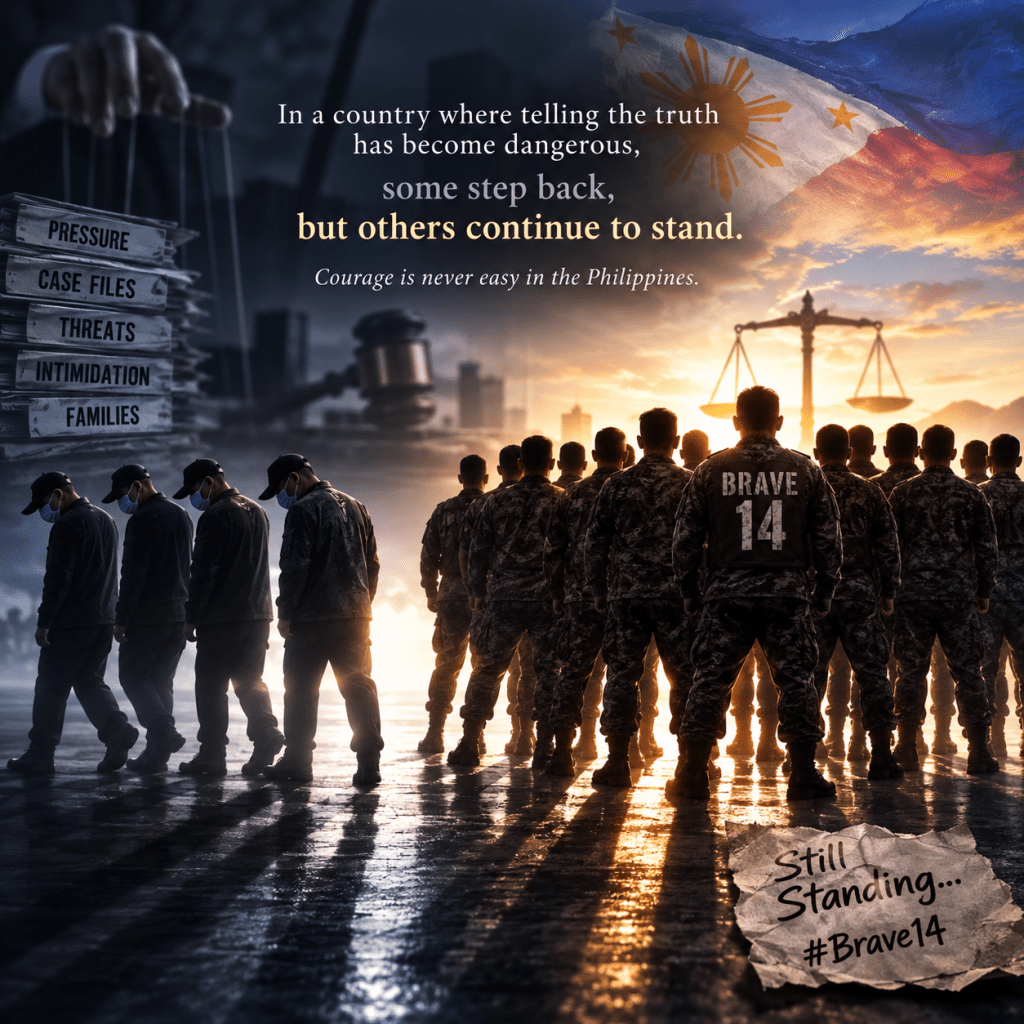
I have to admit that the news about the four ex-Marines changing their statements left me deeply disappointed.
Maybe “disappointed” is not even the right word. There is something heavier about watching people who were once willing to speak suddenly step back. In a country already struggling with corruption, political pressure, and a lack of trust in institutions, moments like this can make you wonder whether there is still any room for ordinary people to stand up against powerful interests.
For a while, I felt angry.
Then I thought about it more carefully.
And I realized that I could not simply sit here and judge them.
It is very easy for us to demand courage from other people. We can say, “Stand your ground.” We can say, “Tell the truth no matter what.” We can call someone a hero when they are willing to risk everything.
But what if “everything” includes your children?
What if it includes your wife or husband, your parents, your home, your livelihood, and the future of the people who depend on you?
That changes the question completely.
These ex-Marines are not just names in a political controversy. They are human beings with families. They have people who love them and people who depend on them. Whatever we may think about their decision, we should not pretend that the pressure they are facing is imaginary.
Imagine knowing that the people who are supposed to protect you may not be able to protect you at all.
Imagine watching powerful people with money, connections, lawyers, and political influence fight their battles while you are expected to face the consequences with far fewer resources.
Then imagine going home to your children after making a decision that could put your entire family at risk.
I honestly don’t know what I would do.
And anyone who confidently says they would never break under that kind of pressure may be underestimating what fear can do to a person.
That is why I am disappointed by what happened, but I am not interested in condemning the four.
I would rather ask why telling the truth has become so dangerous in the first place.
That, for me, is the bigger problem.
We often tell people to become whistleblowers. We encourage them to expose corruption and speak about things that others are afraid to discuss. We celebrate them when their stories first come out.
But what happens afterward?
Who protects them when the lawyers arrive?
Who protects their families?
Who pays for their legal battles?
Who makes sure they can still feed their children when speaking out costs them their livelihood?
It is easy to praise courage from a distance. It is much harder to build a society where courage is not punished.
And this is why I find myself thinking differently about the 14 ex-Marines who continue to stand by their position.
I don’t know them personally. I don’t know everything they have experienced. I don’t know what conversations happen behind closed doors or what fears they carry home with them.
But I know this much: continuing to stand when you know there may be consequences requires an extraordinary amount of strength.
Courage is often misunderstood.
People think brave people are fearless.
I don’t think that is true.
I think brave people are often terrified. They simply decide that there is something more important than their fear.
That is what makes the remaining 14 worthy of respect.
Not because they are somehow better human beings than the four who recanted, but because they are making a difficult choice despite knowing what that choice could cost them.
And that brings me to an uncomfortable thought.
If someone offered me a huge amount of money to change my position, would I really be so certain about what I would do?
I would like to believe that I would never compromise my principles.
But life has a way of testing statements we make when we are comfortable.
If you have no family depending on you, perhaps the answer seems simple.
If you have children waiting at home, elderly parents who need you, bills that need to be paid, and the possibility of losing your freedom, suddenly nothing is simple anymore.
That is why I think the real failure is not only what happened with those four Marines.
The real failure is that our system can make people feel that they have to choose between telling the truth and protecting their families.
That should bother all of us.
A healthy democracy should not depend on people being willing to destroy their own lives just to expose wrongdoing.
There should be mechanisms to protect witnesses.
There should be meaningful legal assistance.
There should be protection for families.
There should be consequences for those who retaliate against people who expose corruption.
And most importantly, there should be institutions strong enough that a person does not have to be extraordinarily brave just to tell the truth.
Because if the only people willing to speak are those with nothing left to lose, we are going to hear very little truth.
This is also why I cannot completely lose hope in the Philippines.
Yes, there are days when it feels hopeless.
There are days when you look around and wonder whether anything will ever change. You see political divisions, accusations, corruption allegations, endless legal battles, and people fighting over personalities instead of principles.
It can be exhausting.
But I still believe that a country is not defined only by the people who disappoint us.
It is also defined by those who continue to do what they believe is right even when there is no guarantee that they will be rewarded for it.
The four ex-Marines who recanted are a reminder of how difficult the fight can be.
The 14 who remain are a reminder that some people will still choose to continue.
Both things can be true at the same time.
I can be disappointed by the decision of the four and still understand the human beings behind that decision.
I can respect the courage of the 14 without pretending that they are immune to fear.
And perhaps that is the lesson I take from all of this.
We should stop demanding that people be heroes while giving them no protection for the price of being one.
If we want more people to speak up, we have to make it possible for them to survive after they do.
If we want whistleblowers, we have to protect whistleblowers.
If we want witnesses to tell the truth, we have to make sure their families will not be destroyed because they did.
If we want honest public servants, we have to stop making honesty the most dangerous career choice in the room.
Otherwise, we should not be surprised when people eventually choose safety.
And maybe that is why this whole situation feels so painful to me.
It is not simply about four people changing their minds.
It is about what their decision tells us about the environment in which they were forced to make that choice.
When courage becomes too expensive, not everyone will be able to afford it.
So yes, I am disappointed.
But I am also thinking about the bigger picture.
I hope the 14 who remain standing are protected. I hope their families are protected. I hope the people who come forward in the future will not have to face the same impossible choices.
And most of all, I hope we eventually build a Philippines where telling the truth does not require extraordinary courage.
Because truth should not be a luxury that only the fearless can afford.
Until then, I will continue to respect those who stand even when they are afraid.
Not because they are perfect.
Not because they have nothing to lose.
But precisely because they do.