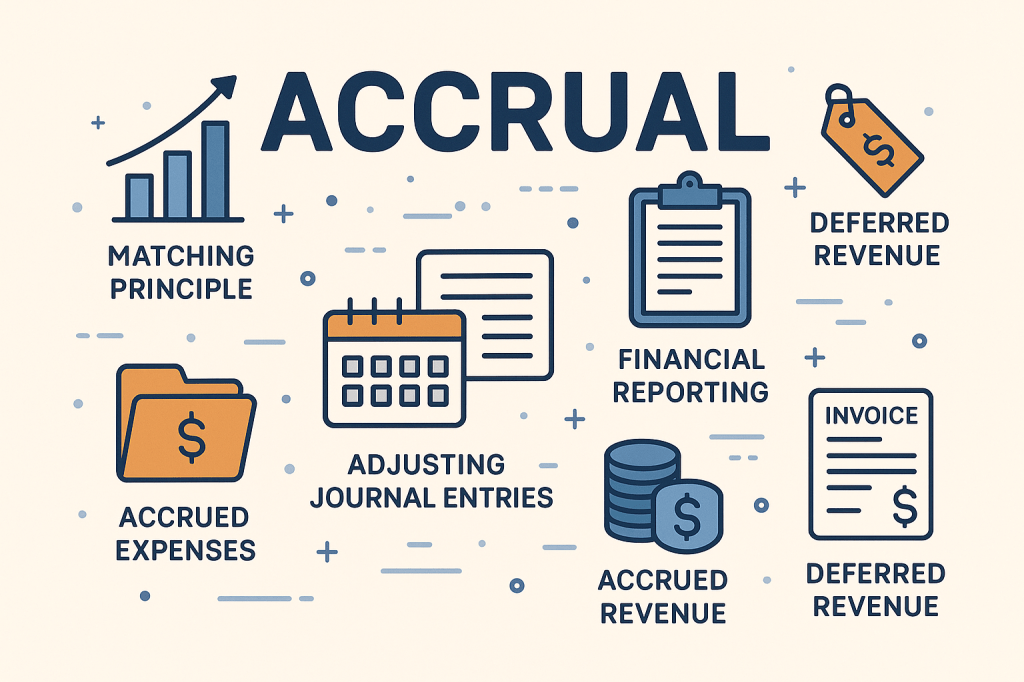
If you’ve ever peeked into the world of accounting, chances are you’ve heard the word “accrual” thrown around. Maybe it sounded complicated, overly technical, or like something only big corporations worry about. But here’s the thing: accruals aren’t just accounting jargon. They’re actually one of the most important tools for making sure your financial records truly reflect the reality of your business.
Let’s break this down in a way that makes sense—and no, you don’t need to be a finance expert to get it.
Imagine you run a small design agency. You finish a big project for a client in late March. You send the invoice on March 30, but the client doesn’t pay until April 15. So, here’s the question: when did you earn that money—March or April?
If you’re thinking March, you’re already thinking in terms of accrual. That’s because the work was done in March. That’s when you earned the revenue, even if the cash didn’t land in your bank account until weeks later. Accrual accounting is all about this idea—recording income and expenses when they happen, not just when the cash changes hands.
This approach matters a lot more than most people realize.
When you only look at cash, you can get a distorted view of how your business is actually doing. A month might look great on paper because a client finally paid an old invoice—but maybe you didn’t land any new projects that month. Without accruals, that kind of nuance is completely lost.
Accruals bring that clarity back.
They let you match income and expenses to the right time period, helping you understand how and when value is really being created or spent. This is what accountants call the matching principle, and it’s a big deal. It ensures that your financial reports line up with actual business activity—not just bank activity.
Here’s another simple example. Let’s say your employees worked the last week of December, but payday falls in January. Under the accrual method, you’d still count that payroll as a December expense—because that’s when the work happened. You “accrue” it so your December profit reflects the true cost of running the business that month.
Now let’s flip it.
Imagine you did some freelance work at the end of the month, but you won’t invoice the client until next week. If you’re using accrual accounting, you’d still count that income in this month’s books. Why? Because you’ve already earned it. It just hasn’t hit your bank yet.
This kind of detail may sound small, but it has big implications.
For one, it makes your financial reports more accurate. It gives you and anyone looking at your books—investors, lenders, even yourself—a clearer picture of how the business is really performing. It also helps you make smarter decisions. When revenues and expenses are properly lined up, you can see trends, forecast more effectively, and spot issues early.
It also keeps you in line with accounting standards. If your business ever needs to be audited, or if you want to apply for serious funding, accrual-based accounting is often required. Organizations like GAAP (Generally Accepted Accounting Principles) and IFRS (International Financial Reporting Standards) expect it. And trust me, you don’t want to be scrambling to adjust everything at the last minute.
So what exactly can be accrued?
A lot more than just wages and invoices. Think unpaid bills, earned but unbilled income, taxes you owe but haven’t paid yet, or interest that’s building up on a loan even if the payment isn’t due yet. All of that gets added to the books before the cash moves. That’s the power of accrual—it recognizes economic reality, not just bank balances.
There’s also a flip side: prepayments and deferred revenues. These happen when you either pay in advance or get paid upfront for work you haven’t done yet. Let’s say you prepay for a year of software in January. With accrual accounting, you wouldn’t just lump the whole cost into January’s expenses. You’d spread it out month by month, matching the cost to the benefit you’re receiving throughout the year.
Same thing when someone pays you in advance. That money doesn’t count as income until you’ve earned it. Until then, it’s a liability—something you still owe in the form of future services or goods.
So when should you actually do accruals?
Typically, they’re made at the end of an accounting period—monthly, quarterly, or annually. Your accountant (or accounting software) will go through and check:
– What work was done but hasn’t been billed?
– What bills or expenses have been incurred but not yet paid?
– What income or cost needs to be spread over multiple months?
Based on those answers, you make what’s called adjusting journal entries—little tweaks to make sure everything lines up correctly.
These entries are usually reversed in the next period. So if you accrued payroll for December, when you actually pay it in January, the system knows not to double-count it. This process, while a bit technical behind the scenes, helps keep everything clean and accurate.
Now, you might be thinking, “This sounds like a lot of work.” And you’re right—it can be. Accrual accounting does require a bit more organization and judgment. You need to track timelines, estimate some amounts (like utility bills or taxes), and make sure your records stay consistent.
But the upside is huge.
Accruals give you a real picture of how your business is doing. Not just how much cash you have, but how efficiently you’re operating. Are your costs rising faster than your revenue? Are you sitting on too much uncollected income? Are there big bills looming that you haven’t planned for yet?
With accruals, you can answer those questions.
Without them, you’re flying blind.
And here’s the best part: you don’t need to be a corporate giant to use accrual accounting. In fact, more and more small businesses are adopting it as they grow. If you have recurring clients, ongoing contracts, employees, or longer-term obligations, switching to an accrual mindset can make a big difference. Most accounting software these days supports it, and a good accountant can help you make the transition smoothly.
At the end of the day, accruals are about truth. They’re about telling the full financial story—when things actually happen, not just when the money shows up. That might sound like a small shift, but it’s a game-changer.
Because when you truly understand what’s happening behind the numbers, you make better decisions. You run a stronger business. And you avoid the surprises that come from relying only on your bank balance to tell you how things are going.
So the next time you hear someone talk about accruals, don’t zone out. Lean in. They might just be explaining the invisible engine that keeps good accounting—and great businesses—running smoothly.



One thought on “The Hidden Power of Accrual: Why It’s the Unsung Hero of Good Accounting”