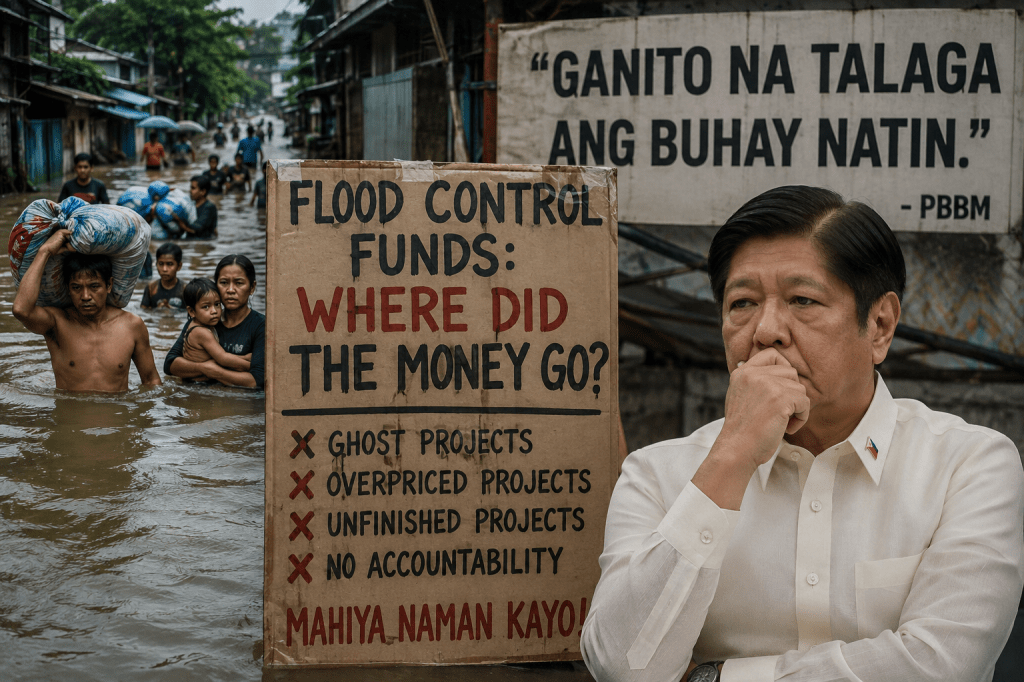
“Ganito na talaga ang buhay natin.”
Those words may describe the painful reality many Filipinos face every time strong storms bring floods, destruction, and loss. But they should never become an excuse for government failure. Climate change is real, and the Philippines will continue to experience stronger and more dangerous weather. Yet not every flooded community, failed flood control project, or ruined livelihood can simply be blamed on nature.
Some disasters are made worse by human decisions.
When public funds worth billions are allocated to protect communities from flooding, Filipinos have every right to ask where the money went and what results were actually delivered. A storm may be beyond human control, but corruption, negligence, poor planning, and unfinished government projects are not acts of nature. Those are failures that people in power must answer for.
President Ferdinand Marcos Jr. once said, “Mahiya naman kayo sa mga kabahayan nating naanod o nalubog sa pagbaha.” It was a strong statement directed at those whose actions or failures may have contributed to the suffering of ordinary Filipinos.
But the question today is simple: does accountability apply to everyone, including the President himself?
It should.
This is not about being pro-Marcos or anti-Marcos. It is about refusing to accept the idea that accountability should only fall on contractors, engineers, government employees, or political enemies while the highest officials remain outside the circle of responsibility. If the government claims that billions were allocated for flood control, yet projects turned out to be defective, incomplete, questionable, or even nonexistent, then the public deserves answers at every level.
The President may not personally build a flood control project. He may not personally approve every contract or inspect every drainage system. But leadership does not end there. The President heads the Executive Branch and signs the national budget into law. In fact, Marcos signed the 2026 General Appropriations Act and publicly described the budget as one that should serve the people and be implemented with accountability.
That is why the issue cannot simply end with, “We will investigate.”
Investigations are necessary, but leadership must also be judged by results. How were these questionable projects allowed to continue? Were warning signs ignored? Were agencies properly monitored? Who was responsible for approving, implementing, and checking these projects? And most importantly, what responsibility does the administration carry for failures that happened while it was in power?
The President himself has acknowledged major problems in flood-control spending. In 2025, his administration said that no fresh flood-control funds would initially be allocated for 2026 because billions already earmarked for 2025 had not yet been fully utilized or disbursed. The government also promised stricter monitoring of project design, implementation, and quality.
But for many Filipinos, this raises another question. If the problems were serious enough to require stopping new allocations and reviewing existing projects, why were they not prevented earlier?
This is where accountability becomes more than a political slogan.
A President cannot take credit when government programs succeed and then completely distance himself when they fail. Leadership comes with authority, but it must also come with responsibility. The bigger the power, the greater the duty to explain.
This does not mean accusing the President of a crime without evidence. Criminal responsibility must be proven through proper investigation and due process. But political and executive accountability are different questions. Citizens have the right to ask whether the President exercised proper oversight, whether his administration acted quickly enough, and whether public money was protected under his leadership.
That is not persecution. That is democracy.
The Filipino people are tired of hearing powerful words after every disaster. They have heard promises of investigations, reforms, punishment, and change. But words cannot repair a destroyed home. A speech cannot replace a lost livelihood. Anger cannot build a flood barrier. And a promise of accountability means little if those responsible never face real consequences.
The flood-control controversy is especially painful because the money involved was supposed to protect people. Public funds are collected from taxpayers with the expectation that government will use them for the public good. When money intended to prevent flooding is allegedly lost through corruption, wasted on poor-quality projects, or spent on projects that do not properly exist, the betrayal is not abstract.
It is personal.
The victim is the family whose home was flooded.
The victim is the worker who lost income because roads became impassable.
The victim is the child who could not go to school.
The victim is the farmer whose crops were destroyed.
The victim is every Filipino who paid taxes and was promised protection.
This is why “Mahiya naman kayo” should not only be directed downward. It should also be a challenge to everyone in power, including the President. If shame is demanded from others, then responsibility must also begin at the top.
President Marcos cannot simply present himself as the person who discovered the problem and then stop there. The public can also ask why the system under his administration allowed questionable projects and massive spending problems to continue. He has the right to defend his administration, but Filipinos also have the right to demand more than explanations.
They deserve accountability.
They deserve transparency.
They deserve to know who approved the projects, who benefited, who failed to monitor them, and why the people were left to suffer while billions were supposedly being spent to protect them.
The storms will continue. Climate change will remain a serious threat. But corruption and government failure should never be accepted as part of the weather forecast.
“Ganito na talaga ang buhay natin” should not become the excuse of a government that has the power, resources, and responsibility to make life safer for its people.
The President must demand accountability from those below him. But he must also accept that leadership places him within the question of accountability, not above it.
After all, public trust does not mean citizens should stop asking questions. It means leaders should be ready to answer them.
And until there are real answers, real reforms, and real consequences, the people will continue to remember those words.
“Mahiya naman kayo.”
Because perhaps the question should no longer be only directed at those who built the failed projects.
Perhaps it should also be asked of those who had the power to stop the failure, but did not do enough before ordinary Filipinos paid the price.