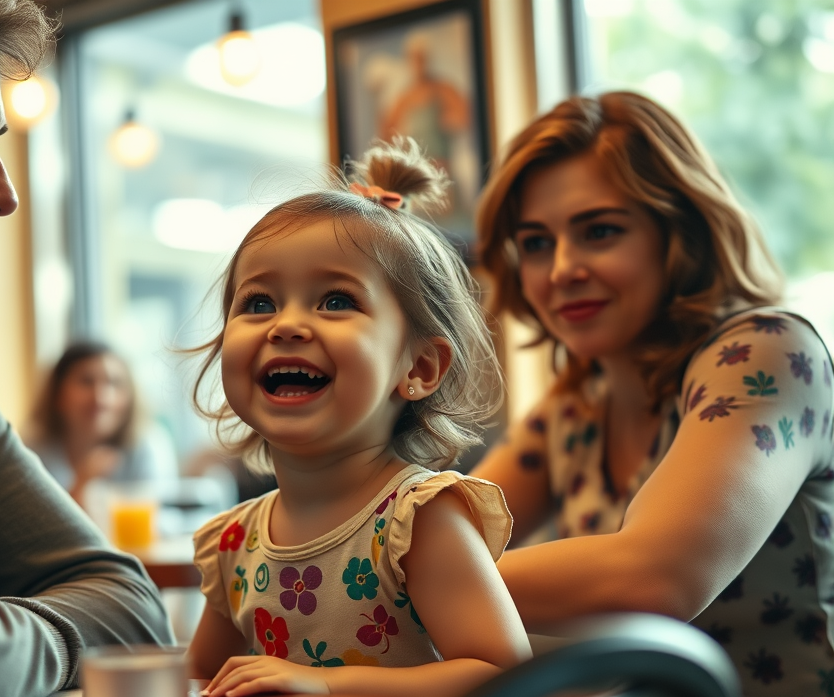
Today, something happened that stayed with me long after we left the restaurant. What was supposed to be a simple family meal turned into a moment that tested my patience, my emotions, and my beliefs about kindness. We were sitting at our table, enjoying the meal and each other’s company. Our little daughter, who is only two years old, was in her usual happy mood. She was laughing, chatting in her toddler talk, and expressing the joy that children naturally have when they’re surrounded by love and excitement. She was not being rude or intentionally disruptive. She was just being a child, full of life and wonder.
But then came the part that broke my heart. The woman at the table next to ours started giving my daughter angry looks. You could feel the disapproval in her eyes. It wasn’t just irritation; it was something harsher, colder. She looked at my child as if she had done something terrible. My daughter noticed it, and I saw the joy fade from her face. Her expression changed from laughter to confusion, then fear. She clung to me, her little arms wrapped tightly around my neck. She whispered that she was scared of the woman, and I had to gently cover her eyes to protect her from that unkind stare.
In that moment, my heart broke a little. No parent ever wants to see their child feel fear or shame for simply being themselves. Especially not for something so innocent as laughter. I could feel anger rising in me. It’s hard to stay calm when you see someone direct hostility toward your child. But what hurt even more was the realization that some adults, for reasons we may never understand, have no patience or compassion for the joy of children.
I kept thinking about what kind of person looks at a happy child and reacts with such visible anger. A child’s laughter should be something that warms hearts, not irritates them. I couldn’t help but wonder what might have made her so bitter, so unkind. Perhaps she never had children, or perhaps she has forgotten what it feels like to see the world through innocent eyes. Maybe her life is filled with silence and control, and the unfiltered energy of a child disrupts that. Whatever the reason, it does not justify her behavior.
Our daughter is only two. She is still learning about the world, still discovering her voice and her emotions. She doesn’t yet understand boundaries in the way adults do. We, as her parents, gently remind her to lower her voice, to be considerate, but she is still just a toddler. To expect perfect behavior from such a small child is unrealistic and unfair. Yet, some people forget this. They look at children as if they should act like adults, and when they don’t, they respond with annoyance instead of understanding.
After the incident, my husband whispered something to me that stayed in my heart. He said, “Don’t stoop down to her level. Rise above it. Show our daughter that there are people in this world who can be cruel, but how we react to them is what defines us.” Those words gave me strength. I realized he was right. The best lesson we could give our daughter that day was not about anger or confrontation, but about grace.
Children learn more from what we do than what we say. If I had responded with anger, if I had said something harsh to that woman, my daughter would have seen me mirror the same bitterness that had frightened her. Instead, she needed to see that kindness and composure are stronger than cruelty. So, I chose to hold her close, comfort her, and continue our meal as if that woman’s glare meant nothing. It was not easy, but it was necessary.
Later, when I thought about it again, I felt sad for the woman too. Not because she deserved my pity, but because it must be lonely to live in a world where you cannot find joy in the laughter of a child. A heart that closes itself to innocence is a heart that misses out on one of the purest forms of happiness life offers. I cannot imagine going through life being irritated by something so natural and beautiful. Maybe she has forgotten how to smile at small things, how to let go of the need for control, how to let life be imperfect.
There’s a saying that a loud child is a happy child, and I believe that deeply. Children express their feelings freely. They laugh when they are happy, cry when they are sad, and talk when they are excited. That is how they grow, how they learn. To silence a child’s joy is to dim their light. The world will have enough moments later in life that will teach them restraint and silence. Childhood should be the one time when they can be free without judgment.
I know that in public spaces like restaurants, we need to be mindful of others. We try to teach our daughter respect, to use her indoor voice, to be gentle. But she’s still learning, and learning takes time. The difference between a kind person and an unkind one is patience. A kind person sees a young family and smiles, understanding that this stage of life is fleeting and precious. An unkind person sees only inconvenience.
That experience reminded me that there are two kinds of people in this world: those who nurture and those who criticize. The nurturing ones are not necessarily parents. Some people without children have the warmest hearts toward them, while some parents have forgotten what tenderness looks like. But when someone reacts with hostility toward a child, it reveals something deep about who they are. No amount of politeness or social charm can hide a heart that lacks compassion.
When I tucked my daughter into bed that night, she whispered again that the woman was scary. I hugged her and told her that sometimes people are not nice, but that doesn’t mean we have to be like them. I told her that the world has all kinds of people, and some of them have forgotten how to smile. I promised her that she should never feel ashamed for being happy. Her laughter is a light, and the world needs more of that light, not less.
I know that as parents, we will face more moments like this. The world isn’t always gentle, and not everyone will treat our children kindly. But our job is to guide them through it with love, to teach them resilience without bitterness. My husband’s words will stay with me: rising above cruelty is not weakness, it’s strength. It’s the kind of strength that shapes the hearts of our children and the way they see the world.
I hope that someday, when my daughter is older, she remembers this not as a painful memory, but as a lesson in grace. I hope she learns that not everyone will celebrate her joy, but that she should never dim it for anyone. The world needs people who can stay kind even when faced with unkindness. It needs people who can see innocence and choose to protect it rather than crush it.
Today in the restaurant could have turned into an argument or a scene. But instead, it became a quiet reminder of the power of self-control, love, and dignity. When we choose kindness over anger, we teach our children something priceless. We teach them that strength isn’t about fighting back—it’s about standing tall, staying calm, and keeping your heart open even when others close theirs.
And so, I am grateful. Grateful for my daughter’s laughter, for her spirit, for the lesson she unknowingly gave me today. Grateful that I had my husband’s wisdom to guide me toward peace instead of fury. The world will always have people like that woman—those who cannot stand the noise of joy—but it will also have children like mine, full of life and love, reminding us what truly matters. And as long as my daughter keeps laughing, I’ll know that kindness won.