I do not drink coffee because it gives me palpitations, but I often find myself around people who love it. They talk about lattes, americanos, flat whites, and more, and I used to just nod along without having any idea what those drinks actually were. It always made me feel a little out of place. So I decided to do some research, and what I found is that most of these names are not as complicated as they sound. They are really just different ways of combining coffee, milk, water, and sometimes foam or flavor. After learning about them, I feel more comfortable when coffee comes up in conversation, even though I am not drinking it myself.
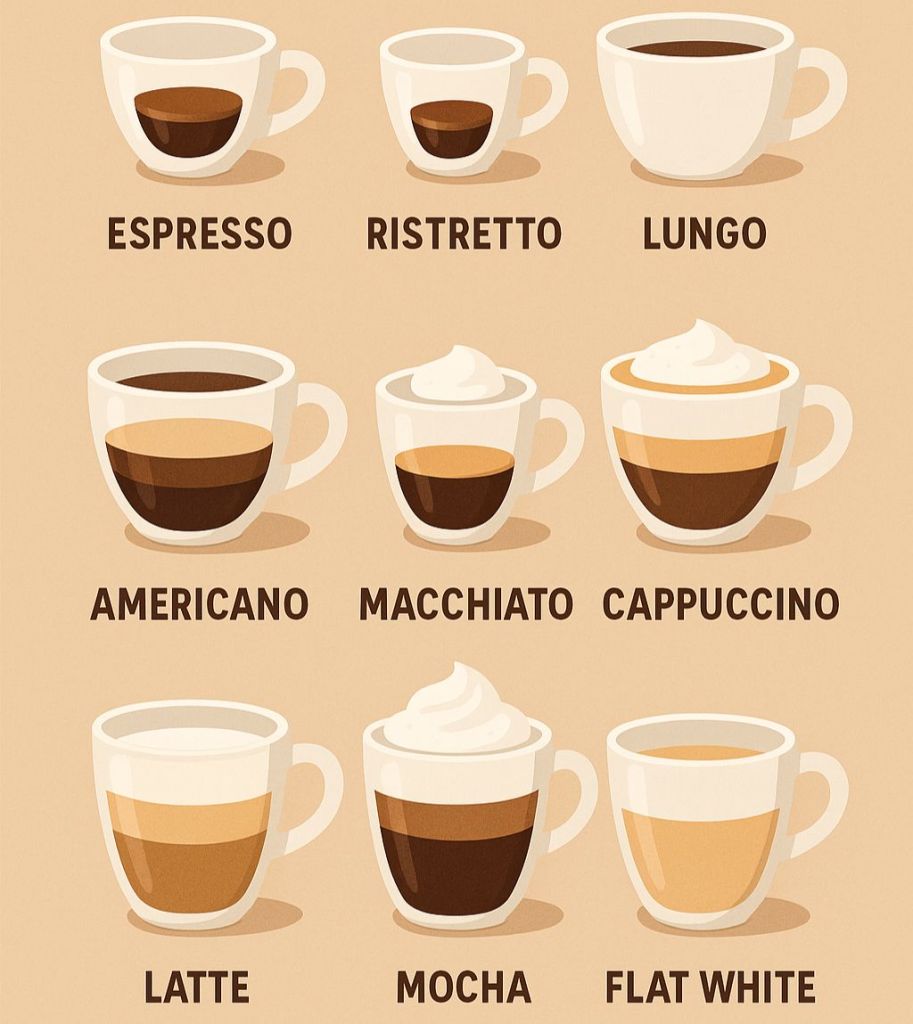
The first thing I discovered is that espresso is at the heart of almost every café drink. It is a small, strong shot made by forcing hot water through finely ground coffee beans under high pressure. It is served in a tiny cup and packs a big punch in both taste and caffeine. Once you understand espresso, all the other drinks start to make sense because they are just espresso plus something else in different amounts.
Take the latte for example. The name comes from the Italian word for milk, and that is exactly what defines it. A latte is espresso with a lot of steamed milk and just a thin layer of foam on top. It is smooth and creamy, and because the milk softens the bitterness, it is one of the most approachable drinks for people who do not like strong coffee. On café menus, lattes are often paired with syrups like vanilla or caramel, which makes them even more like a warm, flavored milk drink with a hint of coffee.
The cappuccino is a little different. It is made of three equal parts: espresso, steamed milk, and foam. Because it has less milk than a latte, the coffee flavor is stronger, but the foam makes it feel lighter. Many cafés dust the top with cocoa powder or cinnamon. It is usually served in a smaller cup than a latte, and I learned that in Italy people often have it in the morning rather than later in the day.
Then there is the macchiato, which means “stained” in Italian. A traditional macchiato is basically espresso with just a touch of milk, enough to stain the surface. It is stronger than both cappuccinos and lattes because the milk is minimal. But when you hear people order a caramel macchiato at a chain café, that is actually more like a sweet latte with caramel syrup. So the same word can mean two very different drinks, depending on where you are.
The americano is much simpler. It is just espresso with hot water added, making it taste closer to regular black coffee but usually smoother. The story behind it is that American soldiers in Italy during World War II diluted espresso with water because it was too strong for them, and that is how the name came about.
Another drink I kept seeing is the flat white. It originated in Australia and New Zealand and looks a lot like a latte, but the difference is in the texture and proportion. A flat white has less milk, so the espresso taste comes through more strongly, and the foam on top is very fine and velvety rather than thick. People describe it as creamy but still bold.
The cortado, which comes from Spain, also aims for balance. It is equal parts espresso and warm milk, with little or no foam. The milk cuts the sharpness of the coffee without overwhelming it. It is often served in a small glass, and from what I read, it is common as an afternoon drink in Spain.
For those with a sweet tooth, there is the mocha. This one is basically a latte with chocolate mixed in. Some places use chocolate syrup, others use cocoa powder, and many top it with whipped cream. It is really a blend of coffee and hot chocolate, which makes it one of the easiest options for people who do not enjoy the taste of plain coffee.
Not all coffee drinks are based on espresso. Regular drip coffee, also called filter coffee, is the kind most people make at home. Hot water passes through ground coffee in a filter, and the liquid drips into a pot or mug. This is what you often see in diners or breakfast tables, and it is usually served in bigger cups meant to be sipped slowly.
Cold brew is another style that has become very popular. It is not just iced coffee. Cold brew is made by steeping ground coffee in cold water for many hours, usually overnight. This slow process produces a drink that is smoother, less acidic, and sometimes naturally sweeter. It is poured over ice and can be enjoyed plain or with milk. People who find hot coffee too bitter sometimes prefer cold brew because of how mild it tastes.
I also came across espresso con panna, which is just espresso topped with whipped cream. That small addition turns it into something closer to dessert. Speaking of dessert, there is also affogato, which is a scoop of vanilla ice cream with hot espresso poured over it. The coffee melts the ice cream, creating a mix of hot and cold, bitter and sweet.
Beyond these familiar café drinks, there are traditional methods too. Turkish coffee, for example, is made by simmering very finely ground coffee with water, often with sugar, in a small pot called a cezve. The grounds are not filtered out, so the drink is very strong and thick. In some cultures, people even read fortunes from the grounds left in the cup.
Learning about these drinks made me realize that coffee culture is not as mysterious as it looks. A latte is mostly milk, a cappuccino is foamy, a macchiato is bold, an americano is diluted, and a mocha is chocolatey. A flat white is creamy but strong, a cortado is balanced, and cold brew is smooth and refreshing. The rest are just fun variations that different countries have developed.
I may never become a coffee drinker, but at least now I can follow conversations without feeling lost. Coffee culture can look intimidating at first with all the foreign names, but once you understand the basics, it is simply different ways of combining the same elements. Knowing this, I do not feel ignorant anymore.