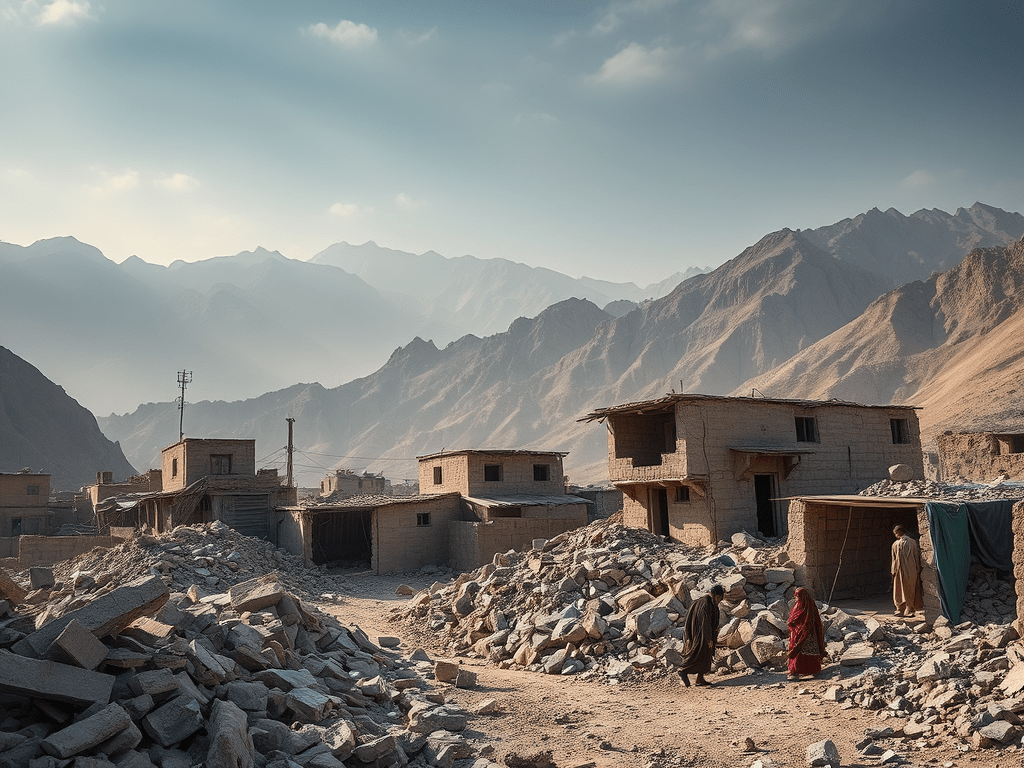
When the news came that more than two thousand people had died in an earthquake in Afghanistan, I felt a quiet heaviness in my chest. It is hard to believe that life can change so completely in a single moment, that in the place many are still trying to heal from past turmoil, another calamity could strike so mercilessly. I think about the children, the mothers, the fathers, the entire families whose homes were their refuge, now reduced to rubble by a force of nature.
I cannot imagine what it must feel like to wake in the cover of night under a trembling sky, to hear the ground shudder beneath you, then to be buried in debris with no time to even whisper a prayer. To know that rescue may come—or not, depending on how far away help is or how broken the path is. In eastern Afghanistan, decades of war have already left a fragility in the land itself, in the homes made of mud and wood clinging to steep valleys, in the roads carved through mountain passes. Now these homes lie flattened, the valleys changed, the roads blocked by fallen rock, and relief struggling to reach the isolated villages.
I feel sorrow for those who are displaced, who have no shelter at all, who might now be sleeping in tents or under open skies. For them there is no soft landing. The cold nights must press hard, and the fear of aftershocks adds another layer of dread. Some of the most recent tremors, powerful in their own right, have shaken entire communities again, leaving more injured and more homes uninhabitable.
I wonder, as I sit here and write this, why I feel safe. Perhaps it is distance. I live far away from fault lines and the rugged terrain that gives little warning. When I think about the people in Kunar and Nangarhar provinces, I recognize they were asleep when the earth gave a sudden jolt. For them, the borders between life and loss vanished overnight. Families lost loved ones, children became orphans, homes turned to dust. Roads were blocked by landslides, stopping ambulances or aid trucks from reaching people in degraded villages. Helicopters are being used where grounds allow, but first responders sometimes must walk miles with backpacks of supplies just to reach the worst-hit places.
As I write, I think of the aid agencies attempting to step into that void, and I feel helpless. Many are running low on funds. Some aid workers have said they only have enough resources to continue for a few weeks. It breaks something inside when I think aid is delayed not just by geography, but also by politics and limits set by international donors who have grown distant since the Taliban returned to power. The world’s attention can seem to drift away just when people are exploding with need.
I cannot help but worry the same could happen to me. It is comforting to know where I live is stable, but I also know how fragile natural forces can be. I hope no quake will ever reach me where I am. And while I am grateful for the protection I have, my heart aches for those who are not so lucky.
There are mothers in those mountains who must gather the shattered pieces of hope to tell their children: we will rebuild. Children who once played in doorways before the ground gave way to dust and debris now sit among makeshift tents, too young to fully understand what was lost, but old enough to feel confusion, fear, and maybe the damp of cold nights when shelter is thin. Aid workers, local volunteers, community leaders keep trying, laying one brick of compassion after another—food, water, blankets, medicine—but they are racing against time, against falling temperatures and diminishing funding.
To think that recovery is already hard when a place is still marching out of war, and then to be hit by a disaster of this scale—that is an unimaginable weight to bear. And yet, here we are witnessing human beings bearing it. In one report, entire villages were destroyed—some places saw up to ninety-eight percent of buildings damaged or obliterated. The landslides, tremors, and the sheer remoteness made every effort more difficult.
I am sorry. I am sorry for everyone who lost a home, a relative, a tranquility that they may never get back. I cannot really say how life could even touch upon that same kind of despair, but I know: all any of us can do in this moment is not look away. To feel with them. To hope help finds them soon enough. To let the prayers and thoughts we send rise silently but insistently in solidarity.