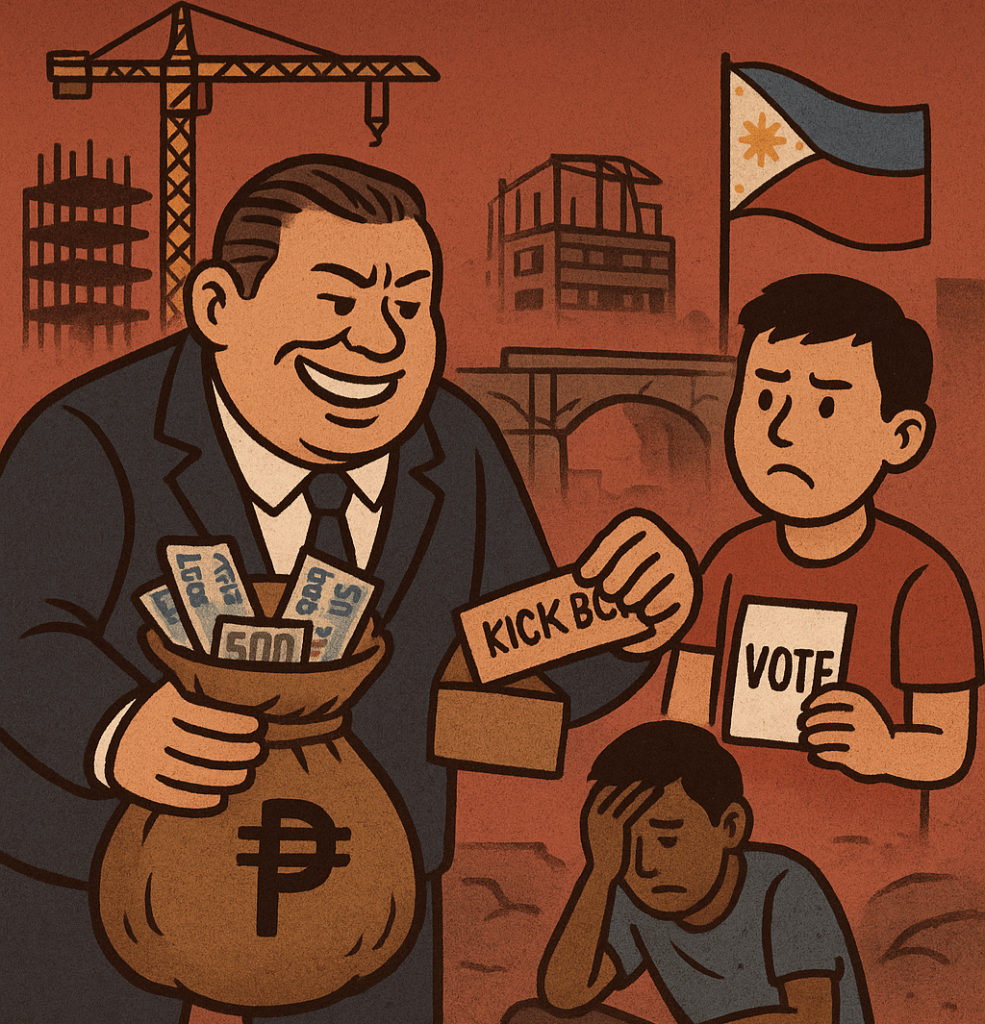
Corruption has become so normal in the Philippines that many no longer react with shock. People expect it. They talk about it over meals, in schools, on the streets, even joke about it like it’s just part of daily life. But behind the jokes and casual conversations, there is a deep pain. A country full of potential is being dragged down by a problem that should have been solved long ago.
In high school, many students already hear stories about how corruption works. Not just in vague ideas but in specific ways. One of the most common involves government projects. Roads, bridges, schools, drainage systems, and health centers. These are supposed to help communities grow and function. They’re supposed to be signs of progress. But what happens is a far different story.
The process often begins with a budget. On paper, the numbers are large. Millions, sometimes billions, are set aside for public projects. It sounds like a good start. But before the money ever reaches the ground, before any cement is poured or steel is bought, there are already hands reaching into it.
Kickbacks are expected. Officials want a cut. Not just one or two, but many. From the top to the bottom, layers of people demand their share. Politicians, engineers, inspectors, suppliers, and even those who approve permits. Each one takes a piece of the budget for themselves. By the time the actual construction begins, what’s left is far less than what was originally planned.

That’s why so many government projects are substandard. You can see it in the roads that crack after a few months. Bridges that seem fragile. Classrooms that fall apart in storms. Drainage systems that cause more flooding than they solve. The materials are often cheap. The work is rushed. Corners are cut. And the people who are supposed to benefit from the projects end up suffering even more.
It’s not because the country lacks money. It’s because the money is stolen.
Many Filipinos already understand this. It’s no longer a secret. But despite the knowledge, the system continues. And what makes it worse is how few corrupt officials are ever punished. Some are even rewarded. They get re-elected. They rise to higher positions. They build mansions, buy luxury cars, and send their children to schools abroad. They live lives of comfort while the poor line up for hours just to get basic medical help or food assistance.
It feels unfair. It feels like karma forgot them.
People are told to vote wisely. To choose leaders who are honest and capable. But during elections, money flows again. Some candidates hand out cash, groceries, or even appliances. Many voters, struggling to survive day by day, are tempted to accept these gifts. It’s hard to blame them. When you’re hungry, a few hundred pesos feels like a lifeline. But that short-term relief leads to long-term problems.
The same thieves are voted back in.
And so, the cycle continues. Year after year. Administration after administration.
What hurts most is the lost potential. The Philippines is rich in natural resources, talent, and culture. The people are hardworking, creative, and resilient. There are so many bright young minds with dreams of becoming doctors, engineers, artists, and leaders. But their dreams are often blocked by a system that does not support them. A system that spends more on personal gain than on public good.
Think about how many schools could be built with the stolen money. How many hospitals could be improved. How many roads could be made safer. How many farmers could be helped. How many jobs could be created. The possibilities are endless if the funds were used properly. But instead of progress, what we see is decay.
Some say it’s hopeless. That corruption is part of Filipino culture. But that’s not true. Culture is not permanent. It can change. And many Filipinos want change. They are tired of the lies. They are tired of being used. They want justice. They want leaders who truly serve. Not just pretend.
Real change starts with accountability. Officials who steal public money must face the law. They must be investigated properly, prosecuted fairly, and punished accordingly. Their ill-gotten wealth must be seized and returned to the government. It should not be hidden in foreign banks or in the names of family members. Every peso must be traced and reclaimed.
But for this to happen, institutions must be strong and independent. The justice system must not be controlled by those in power. Investigators and judges must be protected from threats and bribes. Whistleblowers must be safe. Journalists must be free to report the truth. And citizens must be ready to stand up, not just complain.
Education plays a big role. When people understand how corruption works, they can recognize it more easily. They can demand transparency. They can ask the right questions. They can vote for people based on values, not handouts. Schools must teach not just math and science, but ethics and civic responsibility. Children must grow up knowing that stealing is wrong, even if everyone around them seems to do it.
Technology can also help. Online systems can track budgets and spending. Government transactions can be made public. Contracts can be posted for all to see. If the people can watch closely, it’s harder for officials to hide their actions. Transparency is one of the strongest weapons against corruption.
Of course, change will not happen overnight. It takes time. It takes effort. It takes a lot of courage. But it’s not impossible. Many countries that once suffered from deep corruption have made progress. They created systems that punished wrongdoing and rewarded honesty. They invested in their people, not in personal wealth. They believed in justice.
The Philippines can do the same.
It begins with believing that it can be better. With refusing to accept corruption as normal. With making noise when there is silence. With voting not just with emotions, but with knowledge. With holding leaders accountable, not just during elections but every single day they are in office.
It also means being honest in our own lives. Corruption doesn’t always start big. Sometimes it starts small. A bribe to skip a line. A fake document. A dishonest excuse. When we accept or practice these things, we become part of the same system we hate. So real change must begin in every home, in every person.
There is hope. Always. But it’s not a passive kind of hope. It’s a hope that takes action. A hope that works. A hope that pushes back. A hope that says, enough is enough.
Every Filipino deserves better. Every community deserves clean water, safe roads, and good schools. Every taxpayer deserves to see where their money goes. Every child deserves a future where dreams are built, not stolen.
We may not see all corrupt officials punished today. We may not witness all the justice we want right away. But if we continue to speak up, to choose wisely, to teach our children better, and to believe in the power of honest service, change will come.
And when it does, the Philippines will finally rise. Not because of miracles, but because its people decided they’ve had enough of thieves.
God bless the Philippines.
Disclaimer: This blog post reflects personal opinions and general observations. It does not accuse any specific individual or institution. The goal is to encourage awareness, accountability, and positive change.