Imagine you’re on a project team, and everyone’s trying their hardest—but confusion still creeps in. Who’s supposed to do what? Who makes the final call? Who needs to know what’s happening? These questions can slow things down, drain energy, and invite mistakes. Enter the RACI Matrix—a simple yet powerful tool that answers these questions clearly.
What Is a RACI Matrix?
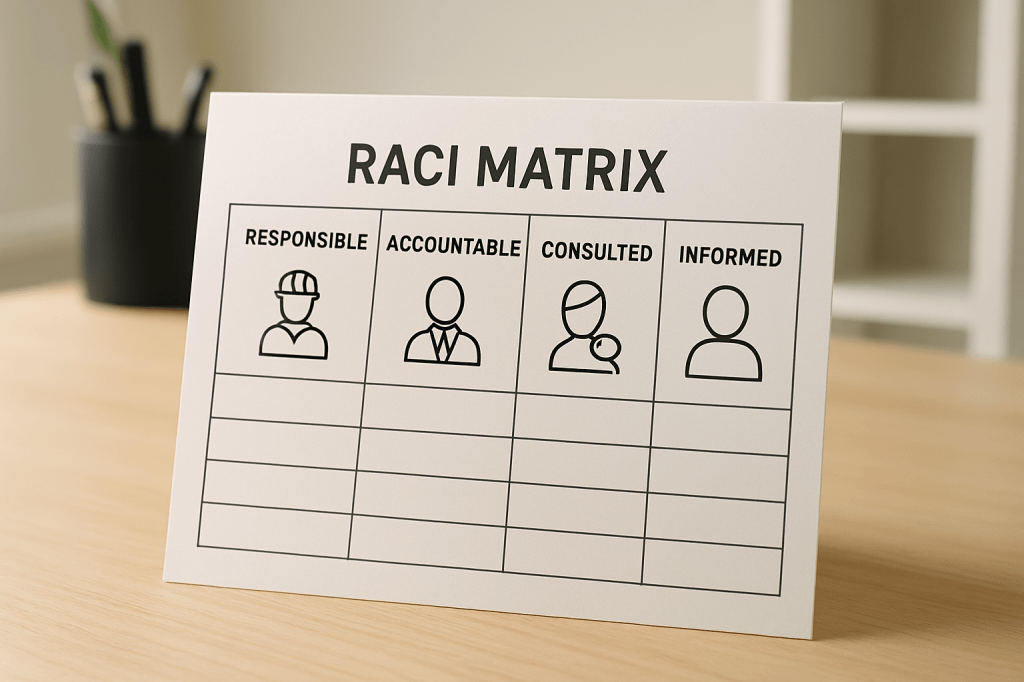
A RACI Matrix is a project management tool designed to define roles and responsibilities across tasks and deliverables. The acronym “RACI” stands for:
- Responsible: Who is doing the work.
- Accountable: Who owns the outcome and makes final decisions.
- Consulted: Whose opinions are sought for input.
- Informed: Who needs updates but doesn’t need to be involved in decisions.
It offers a clear visual layout—usually a table—showing who handles each part of the project. That clarity reduces overlaps, prevents tasks from falling through the cracks, and streamlines communication.
The Four Roles in Detail
1. Responsible
The person or people putting in the work. They’re “hands-on,” executing tasks from start to finish.
- Example: Designing a website mockup.
- Why it matters: Work needs to get done—and someone must do it. Only one or two people should be labeled Responsible to avoid diffusion of accountability.
2. Accountable
The one individual who’s ultimately answerable for the task. They must sign it off and own any consequences.
- Example: Project manager or team leader who approves the website design.
- Why it matters: Clear ownership ensures decisions are made swiftly, and nobody passes the buck.
3. Consulted
People whose feedback is required before execution. They’re experts or stakeholders whose views shape the outcome.
- Example: UX specialist, marketing manager.
- Why it matters: Two-way communication here ensures all relevant voices are heard before moving forward.
4. Informed
Those who need status updates but aren’t involved in decisions or detailed work.
- Example: Upper management, cross-functional teams.
- Why it matters: Awareness keeps stakeholders aligned and prevents surprises.
Why Use a RACI Matrix?
1. Reduces Confusion
No team member hesitates, asks “Who’s on this?”, or duplicates work. Everything is clearly assigned.
2. Improves Accountability
Teams know who owns each part. That keeps productivity steady and ensures high standards.
3. Enhances Communication
Consulted people know they’ll be asked, and informed people expect updates. That keeps communication structured and efficient.
4. Speeds Up Decisions
With a clear approver (Accountable role), choices don’t get stuck in limbo or bogged down in endless debate.
5. Supports Project Planning
Mapping out roles and responsibilities early ensures all gaps get identified and filled before project launch.
When to Use a RACI Matrix
- New or complex projects: Where roles are likely to overlap or create confusion.
- Team expansions or restructures: When new members join, and tasks shift around.
- Cross-functional collaborations: When multiple departments or stakeholders are involved.
- Post-mortem analysis: Clarify where responsibility gaps caused issues.
- Ongoing workflows or processes: Define clear roles for recurring responsibilities.
How to Create Your RACI Matrix
Follow these steps to build one tailored to your project:
Step 1: List Tasks or Deliverables
Break the project down into manageable components: research, design, testing, launch, etc.
Step 2: List Roles or People
Include team members, functional roles, or external stakeholders you need to involve.
Step 3: Set Up the Table
Draw a grid: tasks on the left side (rows), roles across the top (columns).
Step 4: Assign R, A, C, I
Decide who fits each role for each task. Keep roles focused—no more than one Accountable per task; ideally only one or two Responsible.
Step 5: Review for Balance
Aim for:
- Exactly one Accountable per task
- No conflicts between roles
- Even workload distribution for Responsible roles
Step 6: Share and Clarify
Present the draft to your team and stakeholders. Walk through each task-role relationship. Adjust based on feedback.
Step 7: Use Throughout the Project
Keep the matrix visible in team meetings, planning docs, or project tools. Use it to guide decisions and track progress.
Common RACI Pitfalls & How to Avoid Them
- Overassigning Consulted or Informed Roles
- Keep those lists limited. Too many opinions or updates lead to delays.
- Skipping the Accountability Role
- Every task needs an “owner.” Without one, decisions stall.
- Leaving Tasks Unassigned
- The “dead man’s blank” problem: every row and column should have at least one R and one A.
- Ignoring Changes
- Roles may shift as the project evolves. Treat your RACI Matrix as a living document.
- Confusing Responsible and Accountable
- Responsible do the work; Accountable approves and owns the outcome. Clarify at the start.
Example RACI Matrix Table
Here’s a simplified view:
| Task | Designer | Developer | QA Tester | Project Manager |
|---|---|---|---|---|
| Draft UI Mockups | R | A | ||
| Review User Flow | C | A | ||
| Build Front-End Interface | R | A | ||
| Conduct QA Testing | R | A | ||
| Deploy to Production | R | A, I |
- The Project Manager is Accountable for each task.
- Designers, Developers, QA Testers are Responsible for their work.
- User Flow input is Consulted.
- Project Manager is Informed during Deployment.
Tips for RACI Success
- Start early in planning to identify gaps before they bite.
- Keep it simple—don’t over-engineer your matrix.
- Communicate roles in kick-off meetings and documentation.
- Update when needed if team members shift or scope changes.
- Pair RACI with other tools, like Gantt charts or Kanban boards, for better tracking.
- Celebrate clarity when decision-making becomes streamlined!
Frequently Asked Questions
Q: Can someone be both Responsible and Accountable?
Yes—but usually only in small teams or solo setups. In bigger teams, these roles should be separated to maintain objectivity.
Q: What if there are multiple Accountables?
Avoid this—multiple Accountables lead to decision conflicts. If needed, break the task into sub-tasks with distinct Accountables.
Q: How often should I update the matrix?
Any time there’s a major scope change, new team members join, or a new phase begins. Treat your matrix as a living tool.
Q: Can I use RACI for non-project activities?
Absolutely! Use it for ongoing processes like monthly reporting, system maintenance, or workshop planning.
RACI in Action: Sample Use Case
Project: Launching an Online Learning Course
- Identify Tasks
- Curriculum design, video production, platform setup, marketing, launch.
- Determine Roles
- Instructional Designer, Video Editor, Platform Manager, Marketing Lead, Project Sponsor.
- Build the Matrix
| Task | Instructional Designer | Video Editor | Platform Manager | Marketing Lead | Sponsor |
|---|---|---|---|---|---|
| Define learning goals | R | C | C | A | |
| Script & record videos | R | C | C | I | |
| Edit & publish videos | R | A | I | I | |
| Set up course platform | R | C | I | ||
| Launch campaign | C | C | R | A |
Everyone knows who’s doing what, who signs off, whose input is needed, and who just needs updates—a recipe for clarity!
Beyond RACI: Variations & Extensions
- RASCI: Adds an “S” for Supporting—those who help but aren’t fully Responsible.
- RACI-VS: Introduces Verifier and Signer roles for high-stakes deliverables.
- CAIRO: Adds O for Omitted—those excluded—useful in large and complex orgs.
- RACI PD: Splits Responsible into Driver (lead) and Performer (task performer).
Use these variations when projects are large, complex, or highly regulated.
Tools for RACI Matrix Creation
- Excel or Google Sheets: Great for quick tables and simple sharing.
- Project management software: Most tools like Asana, Trello, Monday, or Jira allow tagging or integration.
- Visualization tools: Lucidchart, Miro, or Whimsical help in visual team workshops.
Embrace Clarity, Boost Efficiency
The RACI Matrix is more than project bureaucracy—it’s a clarity tool that puts everyone on the same page. Whether you’re working on a small task or steering a massive initiative, defining who’s doing what, who owns decisions, and who stays in the loop makes everything run smoother.
Start simple. Keep it flexible. Review it often. Use your RACI Matrix with confidence and watch your team communicate better, move faster, and achieve more—all with less confusion. That’s a blog-perfect ending!
Quick Reference: RACI Essentials
- What: Tool to assign roles across project tasks.
- Why: Reduces confusion and clarifies ownership.
- Who: Responsible, Accountable, Consulted, Informed.
- How: List tasks + roles → assign R/A/C/I → review & communicate.
- Tips: Keep one Accountable, limit Consulted/Informed, update often.