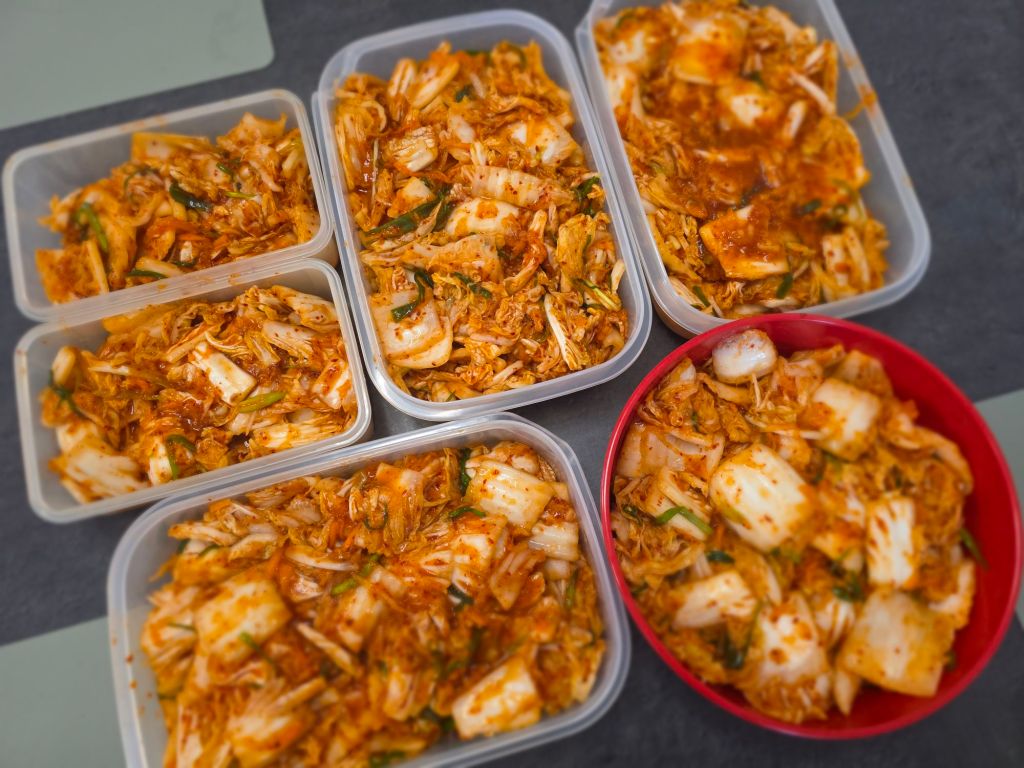
Last night, I stayed up a little later than usual, not because of a drama cliffhanger this time, but for a different reason: cabbage. I had started prepping napa cabbage for kimchi, letting it rest overnight with salt to draw out the excess water. It’s always the first step, and even though it’s simple, it feels like the beginning of something exciting. This time, I made a bigger batch than usual. I don’t know what got into me—maybe just the growing love for the process, or maybe I finally accepted that a small batch disappears way too fast in my house.
Kimchi-making is a rhythm. Once you get into it, it feels oddly satisfying. There’s a quiet pride in it too. It’s not just about mixing ingredients and letting them ferment. It’s more personal than that. Every time I make it, it feels a little different. I adjust the balance between spicy and salty, try new twists with the seasoning, and hope that it turns out well. There’s something really grounding about working with your hands like that—slicing, mixing, massaging the cabbage leaves until every layer is covered in the fiery red paste.
I didn’t grow up eating Korean food every day. But watching Korean dramas introduced me to a whole new world of flavors. At first, it was curiosity. I’d see characters slurping down spicy noodles, grilling meats, or pulling kimchi from plastic containers during late-night scenes—and suddenly I’d be hungry. It didn’t matter what time it was or whether I had the ingredients. The food looked vibrant and comforting, always shared at tables with laughter or serious, heartfelt conversations. Something about it made me want to experience those meals too.
So, I started with what I could find. A jar of store-bought kimchi. Korean instant noodles. Then, I tried making simple recipes at home. Eventually, that led to trying to make kimchi myself. The first time felt like a small victory, even though it wasn’t perfect. The cabbage was a little too salty, and the flavor wasn’t quite right. But I loved the experience. I loved that I made something that connected me, in some way, to a culture I admire.
There’s something deeply nourishing about kimchi—not just nutritionally, but emotionally. Fermented foods are known to be good for gut health, rich in probiotics and vitamins. But beyond the science, it just feels good to eat. A small spoonful can brighten a bowl of rice or soup. It cuts through fatty foods, livens up plain ones, and keeps meals interesting. I never feel guilty about eating it. It’s real food, made from real ingredients, with a process that requires time and care. That’s something I respect.
When I look at a container of homemade kimchi sitting in the fridge, I don’t just see food. I see patience. I see culture. I see a bit of my own growth too. A few years ago, I wouldn’t have imagined myself salting cabbage at night and waiting days for fermentation. Now, it’s a little ritual. A kind of therapy. While it ferments, I keep checking it like it’s a living thing. In a way, it is.
Making a lot this time feels like a small celebration. Maybe I’ve grown more confident in my ability, or maybe I just want to share more. Whenever a family or relatives try it and enjoy it, it feels like a quiet success. A lot of love goes into that container. More than people think.
I often think about how food travels across borders—not just physically, but through screens and stories. Korean dramas made me crave dishes I had never tasted. They showed food as something that brings people together. Families eat from the same pot. Friends bond over barbecue. A simple meal can say “I care about you” without words. That emotional layer is what got me hooked. I didn’t just want to eat Korean food. I wanted to understand it. Making kimchi is one way I’ve tried to do that.
The process teaches me patience. You can’t rush it. You have to wait and trust the ingredients. That kind of slow magic is rare these days. In a world that moves too fast, kimchi reminds me that good things take time. It sits quietly in the fridge, doing its thing, developing flavor day by day. It reminds me that things can change gradually but still beautifully.
I’m already looking forward to when this batch is ready. I can almost taste it—sharp, spicy, slightly tangy, full of that signature kimchi depth. I might use it in fried rice, or eat it on the side of a simple meal. Sometimes I even eat it straight from the container, standing in front of the fridge. No shame in that.
People often ask if making kimchi is hard. It’s not, really. It’s just a process. It’s about following the steps, paying attention, and trusting your senses. It’s more forgiving than it looks. You don’t need to get it perfect. Every batch teaches you something. Every mistake leads you closer to your version of perfect.
Watching Korean dramas led me down a path I didn’t expect. It started with entertainment and ended with a deeper appreciation for a culture and cuisine. And now, with kimchi containers in my fridge and gochugaru in my pantry, I feel like I’ve found a little bridge between my world and the one I used to only see on screen.
Kimchi isn’t just a food to me anymore. It’s a habit, a comfort, a connection. And every time I make it, I’m reminded of how much joy there is in learning something new, even if it starts with a cabbage, a pinch of salt, and a drama that made you hungry at midnight.
If you’re curious about what goes into kimchi, here’s a basic list of the ingredients I used this time:
- Napa cabbage – the heart of it all
- Salt – to draw out moisture and begin the preserving process
- Gochugaru (Korean red chili pepper flakes) – for that signature heat and color
- Garlic – lots of it, for depth and punch
- Ginger – to brighten up the flavor
- Fish sauce – for that umami richness
- Sugar – just a bit, to balance the salt and spice
- Korean radish (mu) – for crunch and contrast
- Green onions – to freshen it up
- Apple – for a touch of sweetness and a smoother taste
- Pear – another layer of natural sweetness that makes the kimchi round and rich
- Onion – for an extra layer of flavor and a touch of sharp sweetness
- Carrots – for color, texture, and a bit of natural sugar
- Tiny fermented shrimps (saeujeot) – just a few spoons, for a punch of savory flavor
- Sugar – a touch, to balance the salt and spice
- Sticky rice paste – made by gently cooking sticky rice flour with water and sugar, it helps bind everything together and adds body
It might seem like a lot, but once you get into the flow of making kimchi, these ingredients feel like old friends. Each one adds something unique, and together, they create that complex, addictive flavor that makes kimchi so special. Every batch teaches you something, and honestly, that’s part of the joy