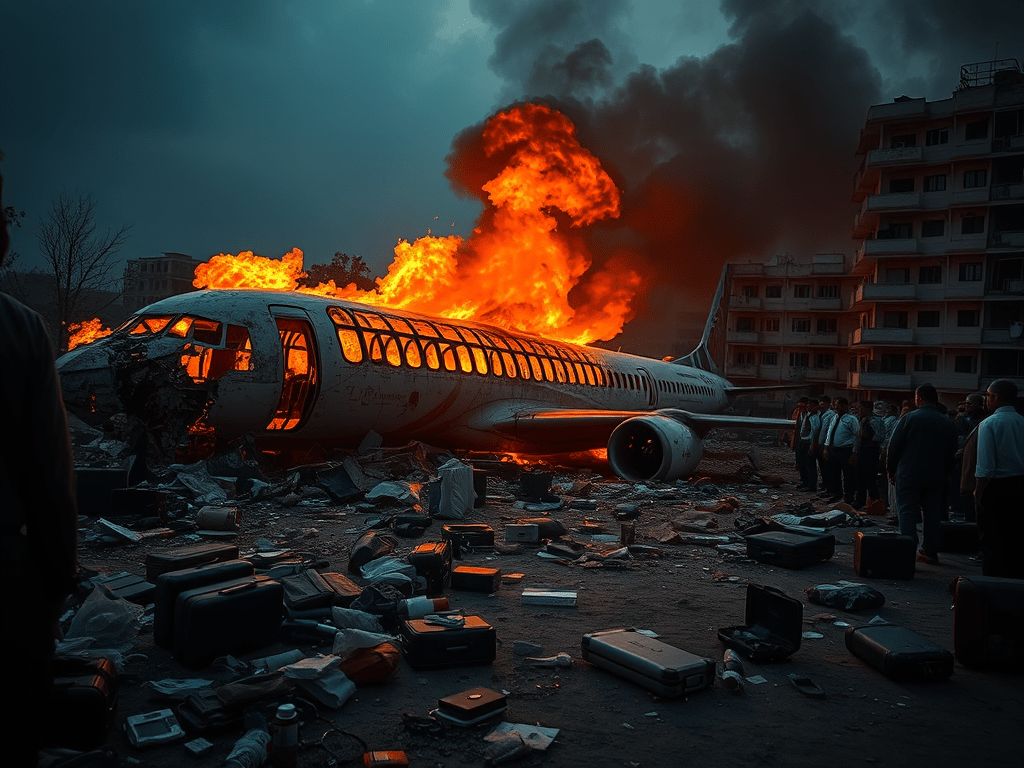
It happened on June 12, 2025. A beautiful summer afternoon in Ahmedabad, India. Air India Flight AI 171, a sleek Boeing 787‑8 Dreamliner, lifted off the runway, bound for London Gatwick. On board were 230 passengers—families, couples, dreamers, travelers—and 12 crew, all anticipating new beginnings: vacations, reunions, perhaps new lives in London, or simply going home. In those hopeful hearts were dreams of sightseeing, strolling by the Thames, exploring big skies and long walks. Some were going home with stories to tell, some chasing new opportunities, and some returning to relatives halfway across the world.
But just thirty seconds after takeoff, fate intervened. The aircraft struggled, lost altitude. It crashed into a hostel block at B.J. Medical College in Meghani Nagar, engulfed in flames. In that instant, 241 people on board lost their lives, along with many on the ground—students having lunch, people walking by—more than 75 others died and over 60 were injured.
In the midst of this unspeakable horror, a single survivor emerged. A British national of Indian origin, seated in 11A, walked away from the wreckage, though badly injured. His survival was described as nothing short of miraculous—“a miracle in seat 11A”. Yet, for most, the tragedy was complete.
In the stillness that followed, the world mourned together. Prime Minister Modi called it “heartbreaking beyond words”. Pope Leo XIV—deeply saddened—offered prayers and solidarity. Nations from Singapore to Africa extended condolences. Flags flew at half-mast, tributes were offered, and vigils were held. This was a moment when grief and unity swept across continents.
And now you feel that knot in your stomach, reading about people whose vacations, relocations, or return journeys included dreams not fully realized. Those “what ifs”—if I were the one boarding the flight, would I be safe? If the engine had worked just one more second differently? If the flaps were positioned slightly better? Could anything have changed?
The answer is: we just don’t know. Investigators from India’s Aircraft Accident Investigation Bureau, along with U.S. NTSB and U.K. experts, are meticulously examining what went wrong—engine thrust, wing flaps, landing gear, maintenance logs, cockpit voice recordings, perhaps contaminated fuel or worst-case scenarios. The regulator is reviewing Air India’s entire Boeing 787 fleet. But until that report is out, the mystery weighs heavily on all of us who fly.
There have been tragedies before—Air India‑Express Flight 812 in 2010, or the Mumbai‑to‑London bombing of Flight 182 in 1985—but this was the first fatal crash of a Boeing 787 Dreamliner since its introduction. We trusted that the advanced technology, layered safety procedures, and global oversight meant flying was the safest way to travel. This crash slams into that trust, forcing us to confront vulnerability in the skies.
Yet somewhere, deeper than anxiety, we remember something vital: if it is our time, it will be our time. Death is unplanned. Danger does not ask for an appointment. Whether at home, on a mountain road, or in a plane, we can never promise eternal safety.
Still, that comfort is thinly veiled. You might think: “So why fly at all?” But for every journey—whether for dreams or duty—it’s the only way. You might be traveling for a job, love, education, family reunion, or self-discovery. To deny travel is to deny life. And yes, if it’s time, there’s little we can do—so it’s better to live, not hide.
This crash smelled of fire, desperation, and shattered plans. I picture a family saying one last prayer before landing, perhaps already imagining their first British breakfast at home. I imagine a couple marking the first stop of their honeymoon. Someone might have been wrapping up a pilgrimage in India and heading back with fresh gratitude. Students heading home after exams. A worker returning after months away. We will never know their stories. But we know that each one carried dreams—some felt trivial, some monumental. All were precious.
Dreams are what make us human. They drive us to board that plane. They push us to pursue new chapters. They remind us that life is unfinished poetry. And yes, aiming for new horizons involves risk—just like any heartfelt endeavor. We accept vulnerability every time we chase love, art, justice. But we also affirm the wonder in being alive.
To the families and loved ones of the 241 who left us too soon: words feel inadequate. We hold you in our hearts and send sincerity across oceans. You entrusted them with dreams. We grieve not only their absence, but the milestones they were to reach: graduations, weddings, laughter by the Thames, long embraces at Gatwick arrivals. We honor them by keeping alive what they stood for—a vibrant hope for tomorrow.
And to the rest of us, reading this, driven by fear: it’s okay to be scared. It’s human. But don’t let it bind you. Speak to your loved ones. Share your concerns. Know that aircraft safety standards are high, that one accident does not define a system thousands of times safer than cars or trains. But also understand it’s alright if your heart hesitates.
Balance your fear with hope. Every flight carries stories like this—but also carries stories of reconnection, of borderless work, of reunion, of relief, of life on the other side of a long journey.
If it ever crosses your mind again—while packing, while queuing, while the seatbelt light dings—tell yourself:
If it’s time, fate will come. But if not, there are stories still waiting for you—the first steps on new soil, the laughter with strangers in cafés, the quiet joy of arriving home. Those memories are worth the tiny risk we take when we lift off the runway.
To the dreamers flying soon, know we are with you—in thought, in hope, and in resolve that life is too meaningful to stay grounded forever.
To the ground-level victims—those students, those neighbors—our sorrow and solidarity are deep. Life is fragile. But we rebuild. Families will heal, slowly, helped by love, memories, and remembrance.
This blog is for the one who fears the next flight, for the hopeful whose passport stamped a thousand dreams, for the families who lost everything, and for the dream left behind when tragedy cuts a journey short. May the names of the 241 passengers and crew, along with those lost on the ground, echo beyond grief—as a testament to life lived in pursuit of hopes, and as a reminder of how precious every departure, every arrival—and every heartbeat—truly is.
Rest in peace, all who departed. 🖤🙏 Safe journeys, all who board tomorrow. 💕🙏
Note: This blog reflects personal reflections on a public tragedy. Factual details—such as casualty numbers, investigation status, and survivor accounts—are based on publicly available reports from Reuters, Associated Press (AP), CBS News, NPR, and The Wall Street Journal, among others. All opinions are my own.