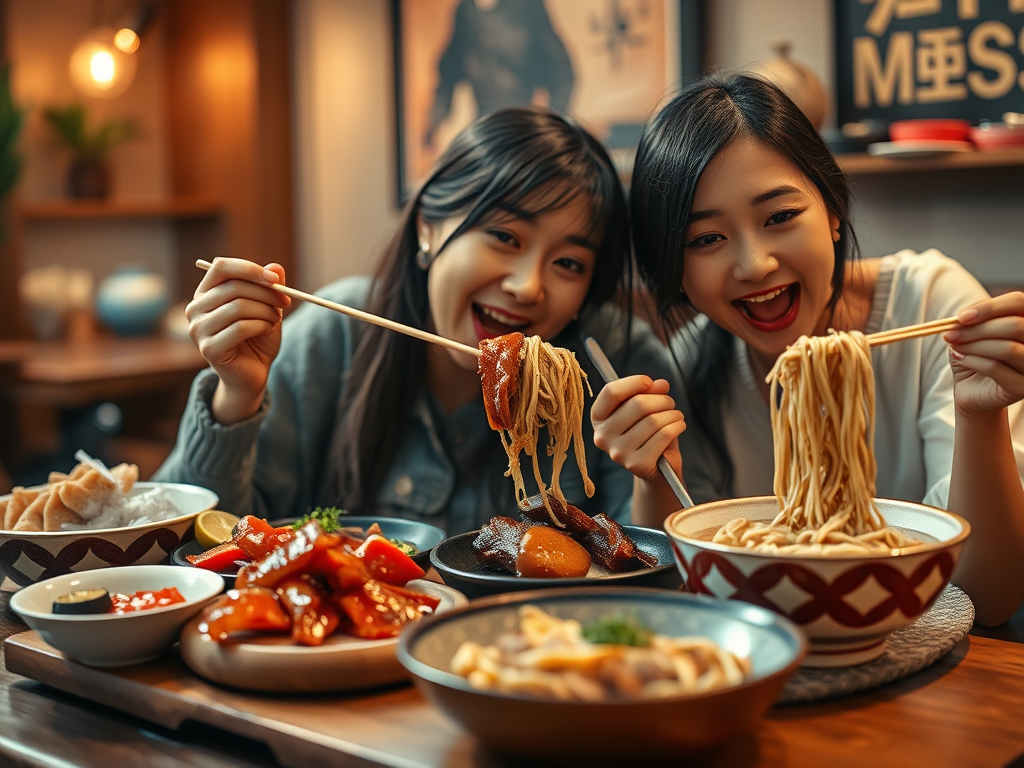
It’s funny how comfort can come from the most unexpected places. For me, it came in the form of strangers on YouTube eating piles of food I couldn’t have, at a time when I couldn’t sleep, couldn’t eat much, and could barely find a position to rest without aching.
Mukbang—especially Korean mukbang—became a strange but soothing companion during the last stretch of my pregnancy. I didn’t plan to get into it—it just sort of happened. One sleepless night led to another, and suddenly, I had favorites. Fume and Boki weren’t just content creators. They were my virtual friends, showing up night after night with platters of food and an effortless joy that made everything feel lighter.
What drew me in wasn’t just the food, although the food was definitely a big part of it. Korean food has always had a hold on me. There’s something about the colors, the textures, the way steam curls from a bowl of ramyeon, the rich, deep reds of kimchi stews, the sizzle of grilled meat—every element is designed to make your mouth water.
And I, with my swollen belly and an appetite that kept coming and going, found comfort in watching someone else enjoy it on my behalf.
Fume, with her delicate mannerisms and almost poetic way of eating, made it feel like a ritual. Her bites were graceful, deliberate. Every chew seemed respectful to the food. Boki, on the other hand, was the complete opposite—and I loved her for it. She could fit impossible amounts of food in her mouth, and somehow make it look hilarious and satisfying all at once. It was like watching two different worlds, both oddly healing.
There’s a strange magic to watching people eat. When you’re pregnant, your senses are all over the place. Smells become stronger, cravings become intense, and sometimes, even looking at food can either make you drool or feel queasy. Mukbang helped me balance that fine line. I could indulge in the idea of food without actually forcing my body to handle it.
In a way, it was emotional eating without the calories. And maybe that sounds silly, but when your body is stretched to its limit, when rolling over in bed feels like a workout, and when food doesn’t taste the way it used to, small pleasures like that matter.
The first time I watched Fume, I remember she was eating braised pork belly with kimchi. I couldn’t take my eyes off it. The glossy red of the kimchi, the fatty layers of the pork belly, the way she wrapped it all in a lettuce leaf—it was mesmerizing.
I felt a little pang of jealousy, not just for the food, but for the way she seemed to be so present in that moment. That kind of mindful eating is something we rarely allow ourselves, especially when life feels rushed. But there she was, dipping, folding, savoring. It was like watching a dance.
Boki, by contrast, was chaotic and joyful. She’d pick up a huge portion of noodles and just go for it. No hesitation. No fear. She’d laugh at herself mid-bite, eyes wide like she surprised even herself. I laughed with her. And in those moments, in the quiet of my home while the world slept, I didn’t feel so alone.
What I also came to appreciate was the intimacy of it all. Mukbang is filmed so close—every bite, every crunch, every slurp is captured. The sound of chewing, which would normally be unbearable in a room full of strangers, somehow became comforting.
ASMR mukbangs turned into lullabies. There’s a softness to those sounds when they’re expected. The crisp snap of pickled radish, the sizzling broth being poured over noodles, the thick clink of metal chopsticks on ceramic—it all created a rhythm that helped me calm down. When I was wide awake at 3AM and the baby was doing somersaults inside me, I’d turn on Fume’s latest video and breathe a little easier.
Another reason mukbang became my go-to was the emotional connection I formed with the creators. There’s something about watching someone eat over time, day after day, that feels personal. You get to know their preferences, their quirks, even their routines.
Fume always thanked the food at the beginning and end. It was simple, but sincere. Boki liked to play with her food, making it look fun instead of just delicious. Watching them helped me feel grounded. While my life was changing in big, overwhelming ways, their presence offered a strange kind of stability. I knew what to expect. I knew how long the video would last. I knew they’d enjoy their meal, and that made everything feel a bit more okay.
As my due date crept closer, I found myself thinking about food differently. I wasn’t just watching mukbangs for fun—I was mentally making a list of all the things I wanted to eat after delivery.
Korean barbecue with thick cuts of samgyeopsal, crispy jeon with soy dipping sauce, bubbling kimchi jjigae with soft tofu, and especially those seafood feasts Boki loved—piles of crab, spicy octopus, grilled abalone. I’d imagine myself sitting at a table with my favorite dishes, eating slowly like Fume, or going all in like Boki. And that hope, that excitement for simple pleasures after the storm, kept me going.
Sometimes people ask why mukbang is so popular. It’s easy to dismiss it as just gluttony or shock value, especially if you’ve only seen clips out of context. But when you’re in it—when you really let yourself feel the experience—it becomes something else entirely.
It’s about connection, comfort, escape, and yes, pleasure. In a world that tells us to multitask everything, watching someone do one thing with complete focus—eating—is oddly refreshing. They’re not checking their phone. They’re not rushing. They’re just eating. And in those quiet, lonely nights, that was enough to help me feel human.
Now that I’ve had my baby, life has changed in ways I couldn’t have imagined. I don’t watch as much mukbang as I used to, mostly because sleep is now a luxury I chase like a dream.
But every now and then, when the house is quiet and I find a moment for myself, I’ll go back to those videos. They still bring me joy. They remind me of how I made it through those hard nights. And they remind me of the strength we find in the strangest of places—like in a bowl of tteokbokki shared through a screen.
If you ever find yourself in need of comfort, don’t be afraid to seek it in unexpected corners. Whether it’s watching someone eat grilled squid with soy dipping sauce or listening to the crunch of perfectly fermented kimchi, there’s no wrong way to cope. And if it makes you smile, even a little, then it’s already done more than enough.