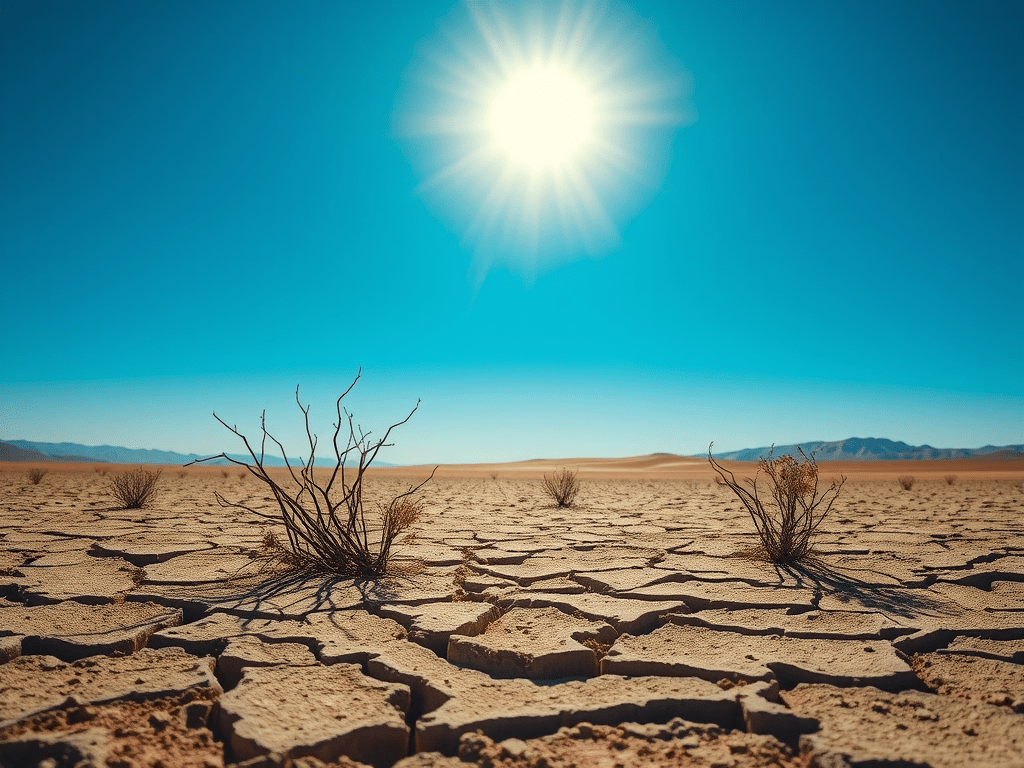
It’s hard not to love a sunny day. That gentle warmth on your skin, the blue sky stretching endlessly above, everything just seems a little more alive. We associate sunlight with joy, growth, clarity. Plants grow, moods lift, things get done. But what if the sun never stopped shining? What if day after day, the sky stayed cloudless, the rain never came, and the heat never let up? What once gave life would begin to take it away. Fields would wither. Rivers would shrink. The earth would crack. Eventually, all that life the sun helped create would dry up and become a desert.
This is how deserts are born—slowly, sometimes imperceptibly, under the weight of too many good days in a row. The sun, which once gave, becomes a relentless force that takes. It’s not because it changes, but because there is no balance. What’s missing is the cool shade, the nourishing rain, the pause. And that’s not just how deserts are formed in the land. It’s also how deserts are formed in people.
We live in a time that glorifies sunshine. Be positive. Work harder. Stay grateful. Smile more. Be bright. The messages are everywhere. In moderation, this is good. We need optimism, resilience, light-heartedness. But when we only accept the sunny parts of life, we start living in denial of the darker, quieter, more complex weather within us. We begin to fear sadness, avoid rest, silence worry, and push through exhaustion. We treat clouds as enemies instead of signs that something needs to soften or slow down.
Over time, if we never let ourselves rain, we dry up.
Think of someone who never rests. They’re always on, always smiling, always producing. From the outside, it might look admirable. But up close, you start to see cracks. They’re tired. Not just sleepy, but soul-tired. Conversations become shallow. Creativity becomes mechanical. The joy they once radiated starts to feel brittle. They’ve been standing under too much sun. Their inner life is becoming a desert.
The metaphor runs deep. In ecosystems, a desert isn’t just a dry place—it’s a place where life struggles to grow. And in people, emotional deserts are formed when we deny our need for the full range of emotional weather: the tears, the rest, the uncertainty, the slowness. When we shame ourselves for feeling down, or numb, or lost, we suppress the very processes that would keep our soil fertile.
Sunshine without rain doesn’t grow anything. It just scorches.
Balance is not just a poetic idea—it’s an ecological truth. The most lush and thriving environments are the ones where the sun and the rain take turns. Where clouds have their place. Where rest is as natural as action. Where the night is just as necessary as the day. In the same way, we thrive when we live in cycles, not streaks. We need moments of joy and sadness, clarity and confusion, activity and pause. Without these natural shifts, we lose texture. We become flat. Even cheerfulness, if unbroken, starts to feel performative.
It’s not that we should seek out gloom. It’s that we should stop fearing it. Let it pass through us. Let it do its work. Emotions are weather, and like weather, they shift when they are allowed to. Sadness, when felt honestly, makes space. Worry, when voiced, often points to something that matters. Anger, when respected, protects us. These are rains. They come, they cleanse, they go. Without them, the inner world dries up.
There’s also a social layer to this metaphor. Think of how we treat relationships. The ones that always appear perfect, full of laughter and affection, may hide unspoken resentments. A friendship that never holds space for vulnerability may feel fun, but not deep. Communities that ignore pain to keep things “positive” may look peaceful, but often feel empty. Sunshine alone cannot build intimacy. The real closeness comes when people weather storms together, when they hold space for discomfort, when they allow truth to surface even if it clouds the moment.
The same goes for success. A career that’s always pushing forward, always aiming higher, may look impressive, but at what cost? Without time to reflect, to pause, to grieve failures or even sit with uncertainty, we lose connection to why we’re even striving. The pace becomes punishment. The sun stops warming and starts burning.
It’s tempting to think more light always means more life. But the lesson of the desert is that this isn’t true. Life comes from balance. And balance requires us to honor the full spectrum of experience—not just the parts that feel good or look good.
Of course, it’s hard to welcome clouds. We live in a culture that associates them with weakness. There’s pressure to be okay, to keep going, to stay bright. But maybe the wisest thing we can do is notice when the sun has been out too long and welcome the shade. Maybe the strongest thing is not to smile through the drought, but to pause and call for rain. To rest. To cry. To let ourselves feel without rushing to fix it.
Deserts recover too, given time and care. Some of the most fragile ecosystems can return to life if protected from further harm and given what they need. Seeds sleep in the sand for years, waiting for a single rain to awaken them. In us too, there are seeds waiting—for softness, for space, for the right kind of nourishment. If we want to live fully, we must learn to recognize the signs of drying up. We must relearn how to water ourselves, how to let ourselves be watered by others.
This doesn’t mean avoiding the sun. It just means knowing when enough is enough. It means respecting the cycle. Celebrating the sunshine, yes—but also making peace with the rain. Because life, like the land, is not meant to be scorched into achievement or constant happiness. It’s meant to be lived in seasons. Letting the sun do its part, and then stepping into the shade when it’s time.
After all, the greenest places are not the ones with the most sunshine—but the ones where the sun knows when to rest.