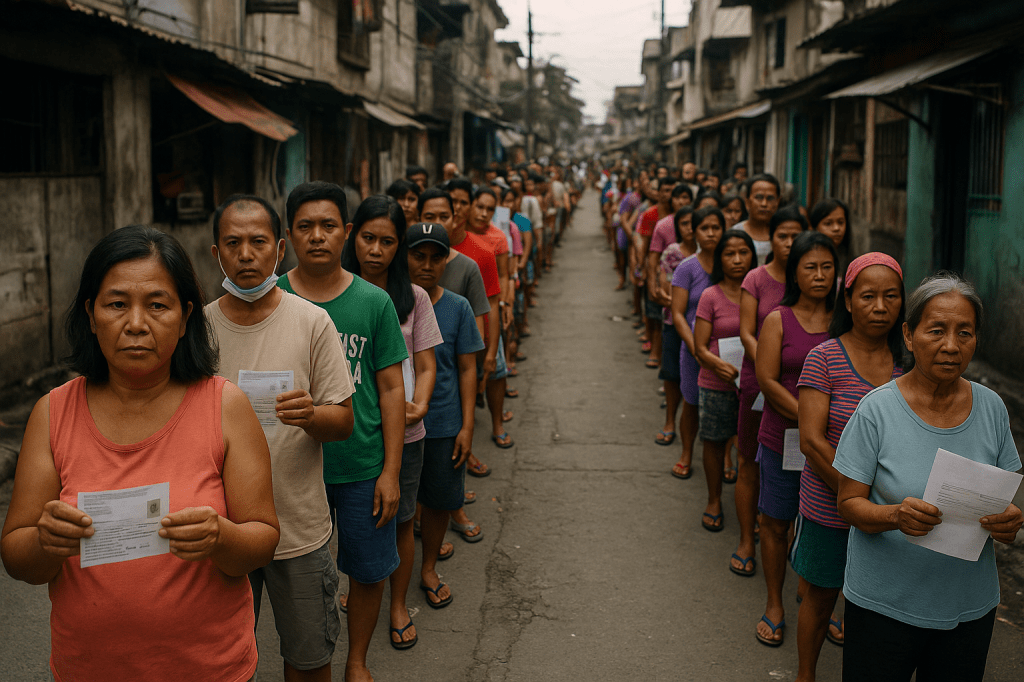
In the Philippines, the word ayuda has become a part of everyday language since the pandemic. It means government assistance—usually financial—given to poor or low-income families. On paper, it’s a noble thing. In fact, every country has some form of aid or subsidy to help those in need. But the way ayuda is being done in the Philippines has turned into something that’s no longer about helping the poor. Instead, it’s slowly becoming a system that rewards dependence, punishes hard work, and drains the country’s resources—with no real long-term plan in sight.
Let’s start with the basics. The Philippine government keeps giving ayuda to millions of families. According to recent estimates, the country has over 110 million people. A large portion of that—millions of households—receive some form of financial aid. Whether through conditional cash transfer programs like the 4Ps, or emergency ayuda during crises, money flows from the government to certain citizens regularly. But where does this money come from?
From taxes. And who pays most of the taxes? The middle class.
Middle-class Filipinos are the ones who work tirelessly, often juggling jobs or enduring long hours just to make ends meet. They pay income tax, value-added tax, and many other hidden charges. Every peso they earn is taxed in some form. But unlike the poor, they do not get subsidies. They are not “poor enough” to qualify for ayuda, but they’re also not “rich enough” to live comfortably. They are stuck in between—working, paying, but not receiving. And that’s where the frustration begins.
Many members of the middle class are fed up. They’re not against helping the poor—especially those who are truly in need. But what they see is a broken system. A system where ayuda is being given to people who are jobless not because opportunities don’t exist, but because they choose not to work. They see neighbors who receive monthly aid but spend their days gambling, drinking, or doing nothing. They see families who’ve depended on ayuda for years and still have no plans of changing their lifestyle.
Of course, this is not to say all recipients of ayuda are lazy or undeserving. There are countless Filipinos who are genuinely struggling—those in remote areas, the disabled, solo parents, or elderly individuals who have no source of income. These people need government support, and they deserve it. But the question is: what percentage of ayuda recipients fall under this category? And how many are simply taking advantage of the system?
The problem lies in how ayuda is distributed. It’s not transparent. There’s no strict qualification process. Sometimes, it’s up to the barangay captain or local officials to decide who gets what. And we all know how this works. If you’re close to the mayor or the barangay chairman, you get ayuda. If you’re friends with someone in the LGU, you’re prioritized. If you’re not, you wait, beg, or get nothing. There are countless stories of double recipients, ghost beneficiaries, or whole families being included even if only one person needs help.
Compare this with a country like Germany. Here, if someone loses their job, they receive support—but not without responsibility. The Arbeitsamt (Job Center) asks them to prove they’re looking for work. They need to submit applications, attend interviews, or take courses to upskill. If they refuse to do so, the aid can be reduced or cut. The system believes in helping people get back on their feet, not keeping them stuck where they are. The money is sent directly to their bank accounts. No waiting in long lines. No need to “ask permission” from a politician. No favoritism. Just a fair, accountable system that tracks every cent.
Meanwhile, in the Philippines, ayuda has become a tool for politics. With the 2028 presidential election coming up, you can already feel it: more generous distributions, more social programs, more handouts. Politicians say it’s for the people. But really, it’s for their votes. By giving ayuda now, they are legally buying loyalty. Poor families who receive aid today are more likely to vote for the same names tomorrow. It’s a cycle of manipulation, disguised as charity.
The government keeps borrowing money to sustain this system. The national debt keeps growing. Billions of pesos are loaned from international organizations or through bonds—money that future generations will have to pay. And what’s it being used for? Often, for short-term, feel-good programs like ayuda, without a real plan to build sustainable livelihoods or uplift communities in the long run.
Wouldn’t it be better if that money was spent on job creation? On better public education? On supporting small businesses? What if, instead of giving monthly cash, the government offered skills training, job matching services, or tools for people to start their own income-generating activities? That way, people don’t just wait for ayuda—they work toward their own future.
Even the name ayuda has started to carry a negative tone. Once a symbol of hope, it now sounds like a symbol of laziness to some. Many middle-class Filipinos joke that they should quit their jobs to get ayuda too. Some are even considering leaving the country—not just for better pay, but for fairness. Because in many parts of the world, working hard is rewarded. In the Philippines, it sometimes feels like the opposite.
This is the danger of normalizing ayuda. It creates dependency. It discourages initiative. And worst of all, it creates division—between those who work and those who wait, between taxpayers and beneficiaries, between the middle class and the so-called masa. A country cannot grow this way.
If the government truly wants to help the poor, it needs to change its approach. Assistance should be targeted, time-bound, and conditional. Aid should be linked to personal responsibility—just like in Germany, or other developed countries. Technology can help make distribution fairer and more efficient. Bank transfers, national IDs, and clear application processes can reduce corruption and favoritism.
The truth is, many Filipinos don’t want handouts. They want dignity. They want opportunity. They want a system where their hard work pays off, and where poverty is not permanent. But as long as ayuda is used as a shortcut to popularity or a bribe for votes, nothing will change.
Ayuda may solve a hunger pang today, but it will not solve poverty tomorrow. It is not sustainable. Not economically. Not socially. Not morally.
The middle class is not angry at the poor. They are angry at a system that punishes productivity and rewards passivity. And unless things change, we’re heading toward a future where more people will choose to wait for ayuda—while fewer and fewer people are left to work for the taxes that fund it. And when that balance tips, the whole system collapses.
Helping the poor should not mean sacrificing the future. It should mean building a country where no one needs ayuda anymore. Only then will we truly rise.
Disclaimer:
This blog post expresses personal opinions and observations about the current state of government aid (ayuda) in the Philippines. It is intended for public discussion and awareness, not to discredit any specific individuals, groups, or government offices. Data mentioned is based on publicly available information and general experiences. The accompanying image is an AI-generated visual representation and does not depict real individuals or actual events. Readers are encouraged to verify facts and consider multiple perspectives before forming conclusions.