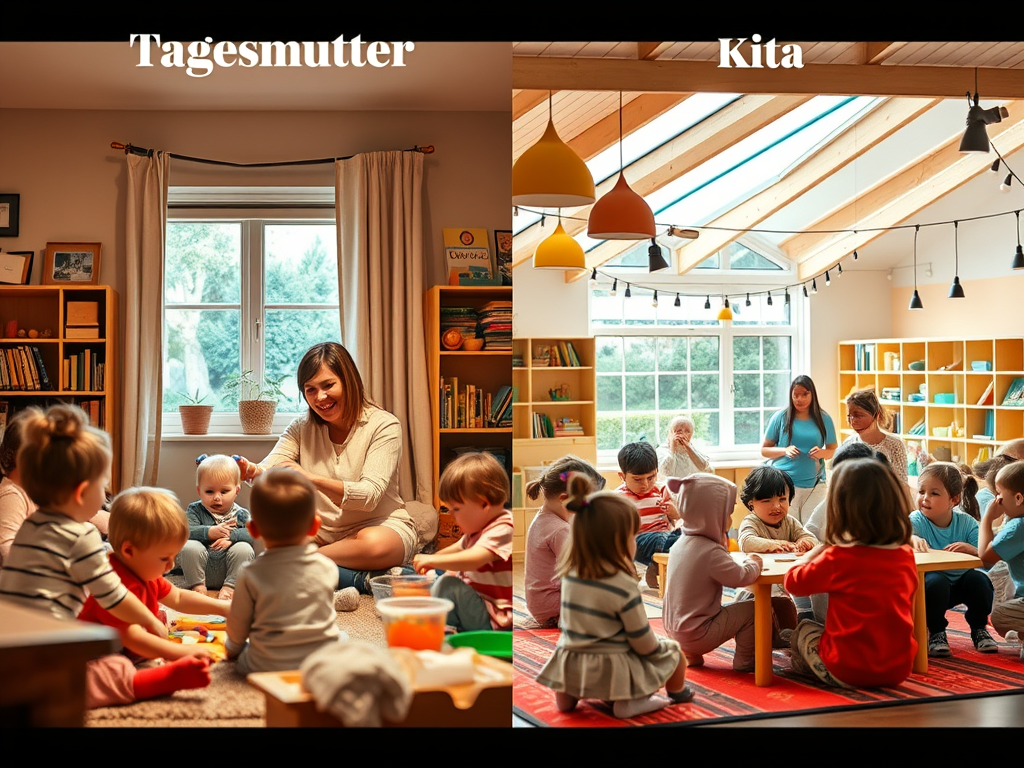
Although I had been living in Germany for nearly a decade, it wasn’t until I became a parent that I truly stepped into the world of childcare here. Until then, terms like Tagesmutter and Kita were just background noise—things I’d heard other parents talk about but never had to consider myself. But after giving birth, I realized how important it was to understand the differences between these two options. I wanted to make the right choice not just based on what others said, but based on what felt best for my child and our everyday life.
A Tagesmutter, literally translated as “day mother,” refers to an independent childcare provider who typically cares for a small number of children in a home-like setting. It could be their own home or sometimes even the child’s home. This arrangement is more personal and often flexible, which initially felt like a comforting option. On the other hand, a Kita—short for Kindertagesstätte—is a formal daycare institution. It’s larger, more structured, and usually has a team of educators working with a bigger group of children.
At first glance, the Tagesmutter felt more appealing. The idea of a familiar face consistently looking after my child, someone they would bond with on a deep level, was very reassuring. There’s something warm about the notion of a child spending their day in a cozy environment, possibly with just four or five other children. It seemed like the kind of setting where a child could build trust and grow at their own pace.
I’ve learned that in Germany, Tagesmütter are trained and licensed, so it’s not just informal babysitting. They receive qualifications in child development and safety, and they are regulated by the Jugendamt (youth welfare office). That gave me peace of mind. I also appreciated the flexibility they often offer. Many Tagesmütter are open to adjusting their schedules or accommodating specific needs. This kind of personalized attention is hard to find in larger childcare settings.
But then, I started exploring Kitas more closely, and my perspective began to shift. While Tagesmütter offer intimacy, Kitas offer structure, variety, and social exposure. Children in Kitas are typically placed in age-appropriate groups and follow a more organized daily schedule. They get to participate in group activities, play with many peers, and experience a routine that gradually prepares them for school life.
One of the things that struck me about Kitas is the team-based approach. Unlike a Tagesmutter who works alone (or sometimes with one assistant), Kitas have multiple educators. That means more supervision, different personalities, and often more resources. If one staff member is sick, the facility still runs. That consistency is important, especially when you’re balancing work and parenting.
From an educational point of view, Kitas offer a richer program. Many incorporate music, crafts, physical education, and even early language learning. Some Kitas are bilingual, or follow specific educational philosophies like Montessori or Waldorf. That variety can be incredibly stimulating for a young child. I began to appreciate how these programs are designed not just to keep kids busy, but to actively support their emotional, social, and intellectual development.
Another difference that stood out is the social dynamic. In a Kita, children interact with a larger group, which helps them learn to navigate relationships, solve conflicts, share, and cooperate. While a Tagesmutter also supports social development, the peer group is much smaller, and the dynamic tends to be more like a little family. That has its charm, but the exposure a child gets in a Kita is closer to real-world social settings. For shy children especially, being part of a bigger group might help them come out of their shell.
There’s also something to be said about facilities. Most Kitas are equipped with outdoor play areas, classrooms, and materials for all kinds of activities. They often offer warm meals, naps in designated sleep rooms, and regular outings. A Tagesmutter, depending on where she works, might not have the same resources. The home setting can be nurturing, but it’s more limited. That said, some Tagesmütter do take children on trips to parks, libraries, or playgroups, and many try hard to compensate with creativity and care.
I did notice that parents who choose Tagesmütter often mention how much they appreciate the strong communication. Because there’s usually just one caretaker, the parent gets a very direct, daily update on how the child is doing. That intimacy is harder to maintain in larger institutions, where communication might be more standardized or handled by different staff.
But for me, reliability and transparency are big priorities. With a Tagesmutter, if she gets sick or needs time off, there’s often no backup. That can leave parents scrambling. In contrast, most Kitas have enough staff to handle such situations. They may not always be perfect, but the system is more robust.
Another issue I came across is availability. Tagesmütter can be hard to find, especially a good one with an opening. Since they care for so few children at a time, spots are limited. Kitas also have waiting lists, especially in big cities, but at least there are more of them to choose from. The search for a spot in either one can be stressful, but I found that Kitas offered more variety in philosophy and location.
Eventually, I realized that what felt more “cozy” at first wasn’t necessarily more beneficial in the long run. My child needed room to grow, both physically and socially. She needed to meet different personalities, try new activities, and face challenges that come with being part of a larger group. I started to value the structure and the wide range of experiences that a Kita could offer.
That’s not to say a Tagesmutter isn’t a good choice. I think it’s ideal for very young children, especially those who might feel overwhelmed in big groups. For babies and toddlers, the personal care and slower rhythm can be exactly what they need. But as kids grow more curious and independent, a Kita feels like a better environment for that next step.
In the end, I’ve come to the opinion that Kitas provide a more holistic, reliable, and enriching experience for most children—especially once they’re past the baby stage. They feel like mini-communities where children can safely explore the world, make friendships, learn routines, and develop a sense of belonging. The transition to school becomes easier, too, because they’re already familiar with group settings and structured days.
So, while I started this journey leaning toward the gentle care of a Tagesmutter, I now find myself advocating for the diversity and depth of experience a Kita can provide. Every child is different, of course, and every family’s situation is unique. But for our needs, and in my honest view, the Kita offers a broader foundation for growth—one that I’ve come to value more than I initially expected.