My husband and I had been eagerly exploring Prague, soaking in the city’s rich history and breathtaking architecture. Every corner seemed to hold something magical—Gothic cathedrals, charming cobbled streets, and grand historic buildings. But nothing prepared us for the moment we stumbled upon something entirely unexpected.
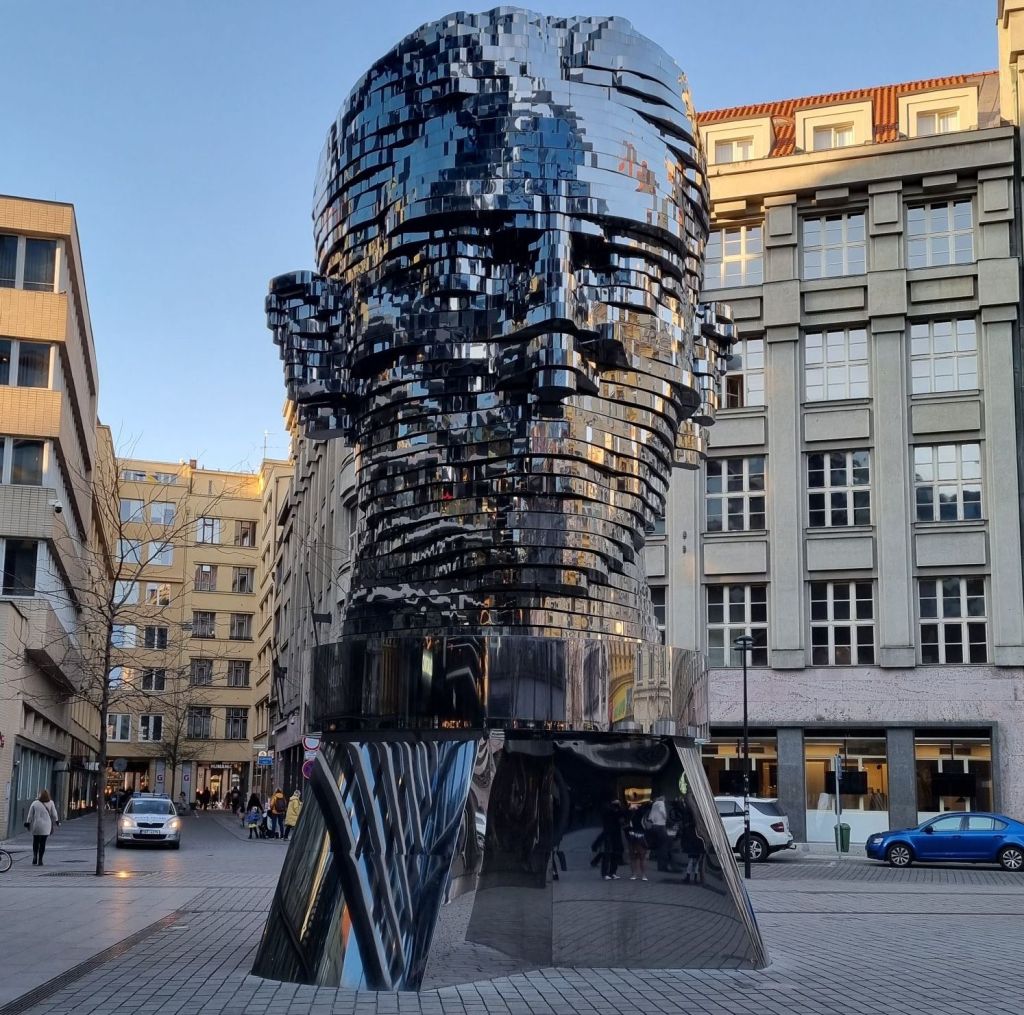
As we turned a corner near Národní třída, we both stopped in our tracks. Before us stood a massive, mirrored sculpture of a human head, its reflective surface catching the fading afternoon light. But what truly made it extraordinary was that it was moving. The entire head, made of dozens of horizontal layers, was rotating—each section shifting independently, sometimes aligning to form a complete face, other times breaking apart into an abstract swirl. It was hypnotic, surreal, and like nothing we had ever seen before.
We stood there for a while, mesmerized. The sculpture, we soon learned, was the Head of Franz Kafka, created by Czech artist David Černý. It was an 11-meter-tall kinetic masterpiece, made up of 42 mirrored panels that moved with precise, mechanical fluidity. As the layers twisted and turned, the sculpture seemed almost alive, constantly transforming right before our eyes.
Watching it, I felt an immediate connection between the artwork and Kafka’s writing. His stories often revolve around themes of identity, uncertainty, and the feeling of being trapped in a world that constantly shifts around you. This sculpture embodied that perfectly—it never stayed still, never settled into one fixed form for long. My husband and I exchanged glances, and I could tell he felt the same way. It was as if we were witnessing a physical manifestation of Kafka’s mind—fragmented, complex, and endlessly thought-provoking.
The mirrored surfaces made the experience even more intriguing. They reflected the city around us—the passing cars, the movement of people, the changing sky. At certain angles, we could even see ourselves in its shifting panels, our reflections appearing and disappearing with each turn. It was as if the sculpture was absorbing everything, blending past and present, reality and illusion.
The more we watched, the more we appreciated the sheer brilliance of its design. We later found out that the movement was powered by an intricate system of motors and gears, allowing each layer to move independently. Without this advanced technology, the sculpture would have been just another statue. But instead, it was something alive, something constantly evolving—just like Kafka’s ever-questioning narratives.
Around us, other visitors were equally captivated. Some stood in silence, simply watching. Others snapped photos and recorded videos, trying to capture the ever-changing beauty of the piece. A few people seemed lost in thought, perhaps contemplating the same ideas we were. It was one of those rare moments where art truly connects people, making them pause, reflect, and feel something beyond words.
As the head continued its slow, deliberate rotations, we talked about what it meant to us. To me, it felt like a metaphor for how life constantly changes, how identities shift, and how nothing ever remains static. My husband saw it as a reflection of the city itself—a place that balances its deep history with a forward-thinking, creative spirit. In that moment, we realized that this was one of the most unexpected yet meaningful highlights of our trip.
Even as we finally decided to move on, we kept glancing back at the sculpture. It was the kind of sight that stayed with you, lingering in your mind long after you walked away. Prague had already enchanted us with its beauty, but this rotating head of Kafka added something deeper—an unforgettable reminder of the power of art, technology, and imagination.