Having a child in a Kita in Germany has opened my eyes to just how different early childhood education is compared to kindergarten in the Philippines. It’s not just about the setting, the language, or the culture—it’s about what is being taught and, more importantly, what is valued in a child’s early years.
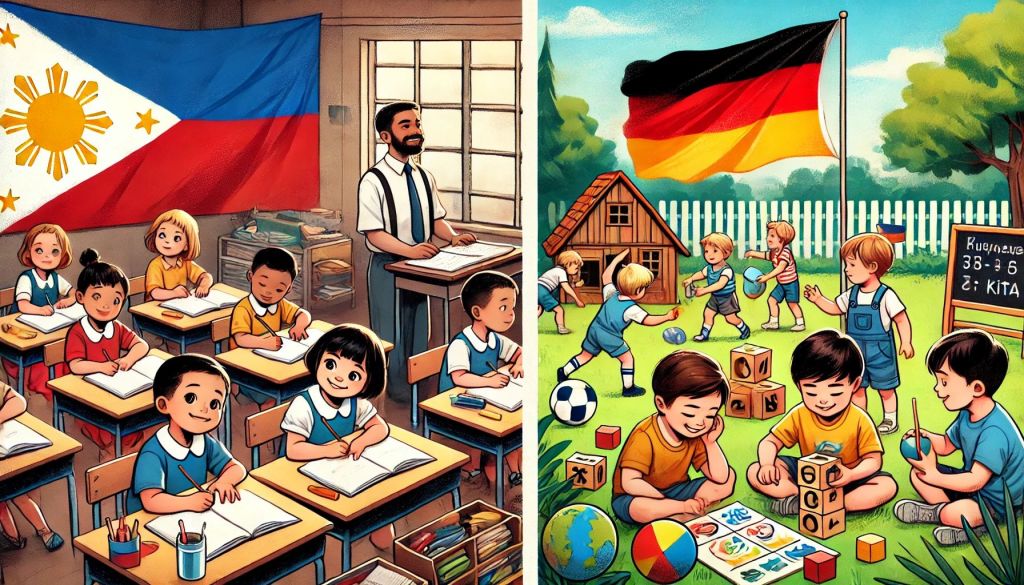
In the Philippines, preschool is structured like a mini version of elementary school. Kids as young as four are already learning to read, write, and do basic math. There are worksheets, assigned tasks, and even occasional tests. The goal seems clear: prepare children for the academic demands of grade school. Parents take pride in how early their kids can recite the alphabet, count to a hundred, or even read simple sentences. Learning is measured by output—how well a child can answer a worksheet, memorize a song, or perform in a class activity.
Kita in Germany, on the other hand, takes a completely different approach. There is almost no formal teaching of reading, writing, or numbers at this stage. Instead, the focus is on social development, independence, and learning through play. Children spend most of their day exploring, crafting, singing, or simply interacting with one another. The belief is that structured academics can wait; right now, children should be learning how to express themselves, solve problems, and navigate the world through experience rather than instruction.
One of the biggest surprises for me was the level of independence encouraged in Kitas. Kids are expected to dress themselves, serve their own food, and even decide how they want to spend their day. There is a strong emphasis on free play, outdoor activities, and hands-on experiences. Unlike in the Philippines, where preschoolers follow a strict schedule, German children are given the freedom to choose their activities, fostering a sense of responsibility and self-motivation.
Another striking difference is the approach to discipline and conflict resolution. In the Philippines, teachers often step in to mediate arguments between children, ensuring everyone follows the rules. In German Kitas, children are encouraged to resolve their conflicts on their own, with teachers guiding rather than directly intervening. This helps them develop social skills and emotional intelligence, something that isn’t always prioritized in more academically driven preschool settings.
While both systems have their merits, experiencing Kita firsthand has made me appreciate the beauty of unstructured learning. It’s a reminder that education is not just about mastering letters and numbers but also about developing curiosity, confidence, and life skills. The Filipino system ensures children are academically prepared, while the German approach nurtures independence and social awareness. Perhaps the ideal preschool experience lies somewhere in between—where learning is both structured and exploratory, and where a child’s natural love for discovery is never lost.